
Comparison of Brands 2026.
We analyze the performance of the 7 brands validated by the platform, with a complete view of the panel, inverter, battery and energy management ranges.
Enphase vs. Huawei
Enphase microinverters vs Huawei string/hybrid architecture: two efficient logics, to be chosen according to the roof and the expected level of control.
Read the comparison →
SunPower Maxeon vs LONGi Hi-MO X6/X10
SunPower targets the very high end (long warranty, premium finish), LONGi targets solid profitability on a large scale.
Read the comparison →
SOLYCO vs. LONGi
SOLYCO emphasizes the product approach and architectural integration; LONGi often dominates on price per watt and availability.
Read the comparison →
LG Home 8 / RESU vs Huawei LUNA2000
Residential storage comparison: LG for certain retrofit configurations, Huawei for very coherent modular integration in new projects.
Read the comparison →
Technologies at a glance
Visualize the position of brands on the Swiss market and quickly compare performance, guarantees and stability.

Brands
7
Yield
22.5%
Warranty
30 years
Update
2026






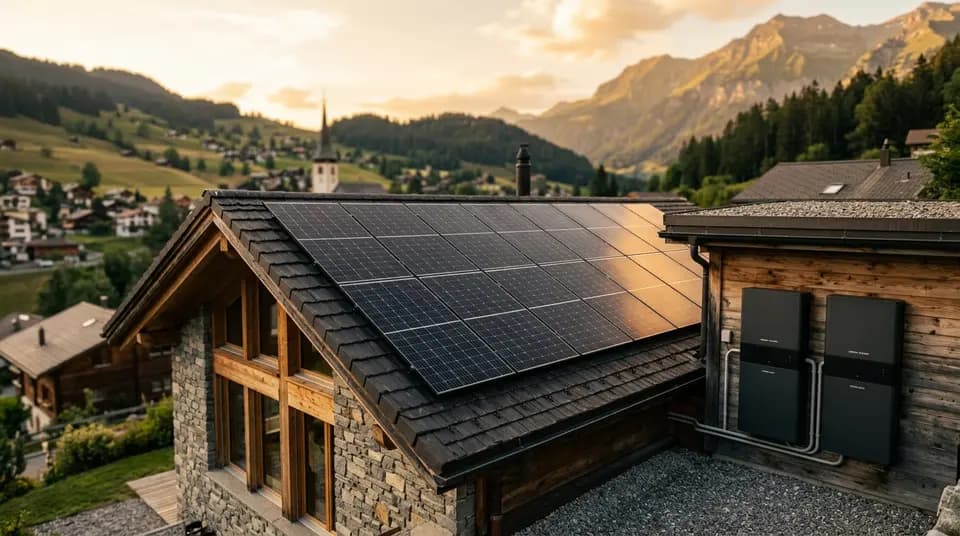
5-in-1 ecosystem (PV + battery + EMS + EV)
Perf.
By components and test conditions
Warranty
By model, country and contract
Manufacturer of intelligent energy ecosystems centered on SigenStor: hybrid inverter, LFP batteries, AI control and electric vehicle charging.
Inverters
Batteries
EV charging
Energy management
See the brand sheet
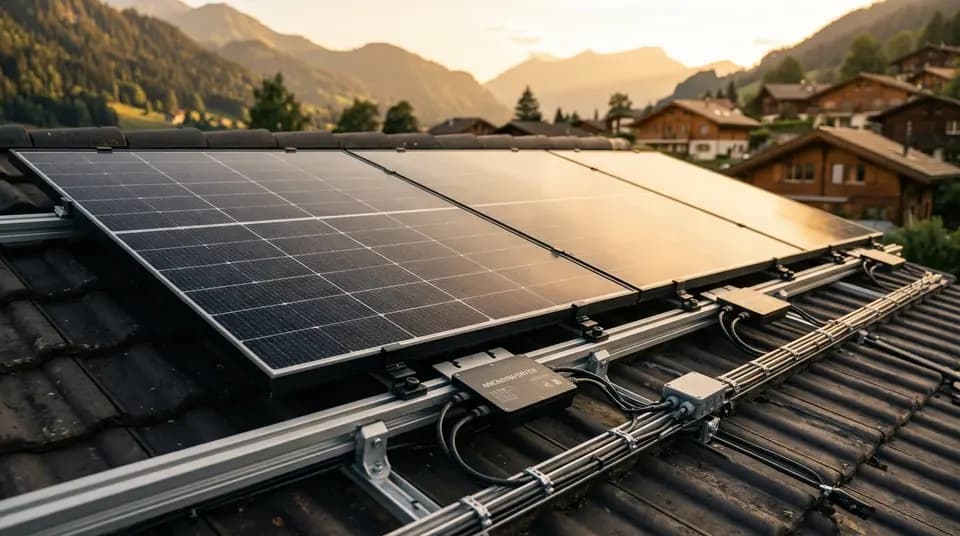
IQ Microinverters
Perf.
By the proposed microinverter
Warranty
By model, country and contract
AC coupled ecosystem recognized for its detailed monitoring, resilience and scalability on complex or partially shaded roofs.
Microinverters
Batteries
Energy management
See the brand sheet
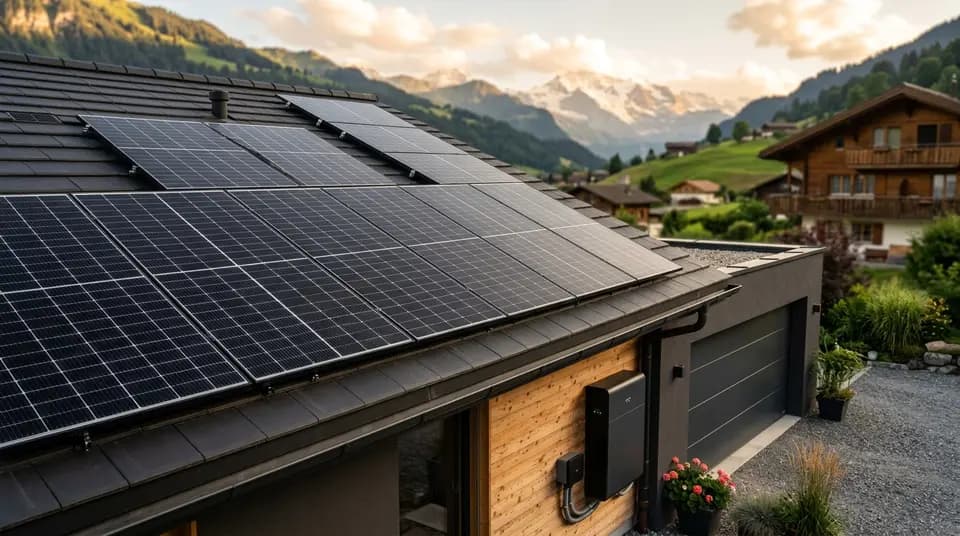
Residential storage and existing solar panels
Perf.
By storage system
Warranty
By model, country and contract
Existing NeON panels, LG Electronics systems and LG Energy Solution batteries: identify each product’s model, compatibility and warranties.
Panels
Batteries
Energy management
See the brand sheet
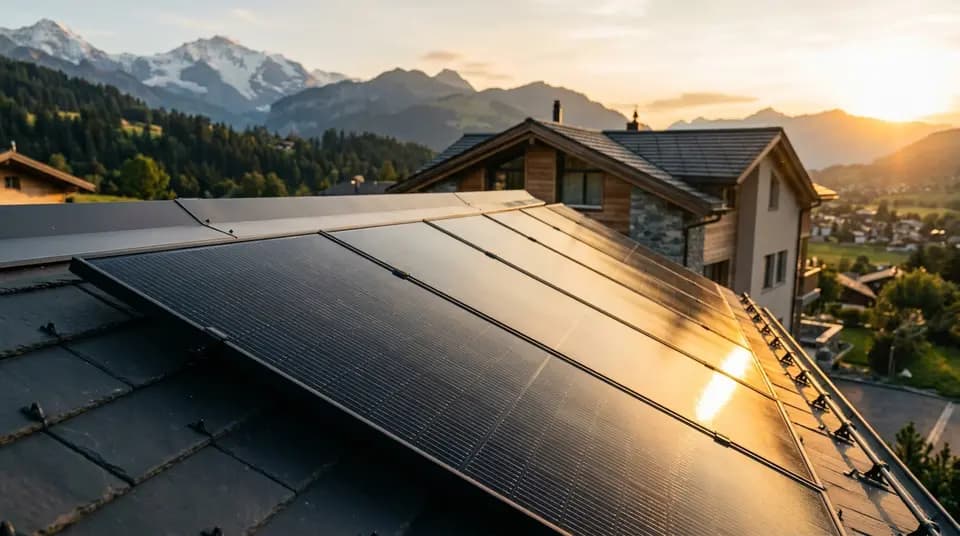
IBC + TOPCon (recent ranges)
Perf.
By module model
Warranty
By model, country and contract
Premium brand for the residential and C&I sector, with ranges focused on long-term performance, roof design and the domestic energy ecosystem.
Panels
Batteries
EV charging
Energy management
See the brand sheet
TOPCon, HJT, back contacts and dual glass
Perf.
By module model
Warranty
By model, country and contract
Quality-oriented manufacturer with Design, Pro and Boost lines, including back-contact modules and next-generation TECC variants.
Panels
Structures
See the brand sheet
Back contacts and other technologies by series
Perf.
By module model
Warranty
By model, country and contract
Very broad portfolio of residential, tertiary and utility modules, with the historic Hi-MO series and new back-contact platforms.
Panels
See the brand sheet
Inverters, storage and energy management
Perf.
By components and test conditions
Warranty
By model, country and contract
End-to-end ecosystem: inverters, optimizers, batteries, backup power and control for the residential and commercial sectors.
Inverters
Batteries
Optimizers
EV charging
Energy management
See the brand sheet
Legal notice
Solar Panel Swiss acts as an information and support platform and does not represent these brands. Brands, trade names, logos and visuals belong to their respective owners. Their presence here does not imply any agency, official business partnership, or endorsement.
If your priority is…
Tight budget, but demanded quality
→ LONGi Hi-MO X6 or SOLYCO Pro
Excellent performance/price ratio on recent N-Type modules, with solid availability on the Swiss market.
If your priority is…
North-facing roof or often overcast sky
→ SunPower Maxeon + Enphase IQ8 microinverters
Premium combination to limit losses per module and maintain robust production in diffuse light and partial shading.
If your priority is…
Priority on sustainability and longevity
→ SunPower Maxeon or LONGi Hi-MO X10
Two long-term oriented platforms with extensive guarantees and high returns, suitable for heritage projects.
If your priority is…
Small roof area, maximum production
→ SunPower Maxeon 7 or LONGi Hi-MO X10
These very high efficiency ranges maximize Wp/m² and make better use of compact roofs.
If your priority is…
All-in-one smart system
→ Huawei SUN2000 + LUNA2000 + EMMA
Coherent inverter+battery+control ecosystem, very practical for advanced self-consumption, EV charging and centralized supervision.
If your priority is…
Multi-brand pro supply
→ SIGENERGY + SOLYCO + Huawei + Enphase
Catalog approach allowing you to compose a complete architecture (panels, conversion, battery, EMS) with strictly validated brands.
Comparison methodology
Our scores are based on four fundamental criteria: surface efficiency (Wp/m²), guaranteed annual degradation (LTD), performance in low light conditions (morning and evening spectrum) and the carbon footprint of production.
Yield data corresponds to the best commercial values of current product lines (2026). The warranties cited are those of the premium series — check the exact conditions with your installer. This analysis is updated periodically and may appear alongside commercial proposals from the site.
To go deeper
In-depth comparison method
Comparing sunscreen brands is not about lining up percentages in a table. A brand is a family of products, a distribution network, a guarantee and a service ecosystem. The ranking becomes useful when it shows what is comparable, what is not and which questions help to decide between two offers for a Swiss house.
Start by defining the scope of the comparison
Before pitting two manufacturers against each other, note the exact product: module, inverter, battery, microinverter or control system. The same brand can offer an entry-level range, a premium range and references intended for sales. Comparing the maximum return of one series to the guarantee of another does not produce a reliable conclusion. The table must always contain the reference, power, dimensions, weight, date of the sheet and the market to which it applies.
The second perimeter is your project. A strong mark on a large roof without shade does not necessarily respond to a small surface with several orientations. An integrated ecosystem can simplify commissioning, but it can also limit future choices. Conversely, a multi-brand architecture may offer more flexibility and require more coordination. There is no superior architecture in absolute terms: there is architecture consistent with your building.
- Identify the product and version, not just the logo visible on the brochure.
- Separate the criteria that concern the module from those that concern the complete system.
- Request a verification date for each piece of data that may change.
Compare modules on an identical basis
For the panels, look at the efficiency, but also the power per square meter, the power tolerance, the temperature coefficient, the mechanical behavior, the weight and the dimensions. A limited roof area may justify more power per square meter; an old roof may favor a lighter module or a different installation plan. The performance guarantee must be read with the degradation method, the claim threshold and the person responsible for the claim.
TOPCon, HJT, IBC and glass-to-glass technologies can have distinct advantages. Don't turn a lab benefit into a bill promise. Actual output depends on shades, ventilation, temperature, wiring and inverter. Request a simulation that uses exact benchmarks and shows losses per month. If a quote uses a generic yield but the ranking quotes a premium series, the comparison must be started again.
Compare inverter and Storage as a System
An inverter transforms production, measures flows and can control a battery, a terminal or a flexible load. Two devices of similar power may have a different number of MPPTs, different current limits and a more or less complete backup mode. Compare the connection diagram, protections, charging and discharging power, shadow management, monitoring and probable replacement before declaring a winner.
For a battery, distinguish nominal capacity and useful capacity. Check the available power, round trip efficiency, room temperature, warranty, extension and emergency circuits. A closed ecosystem can simplify support but make future replacement more dependent on a single channel. An open solution may offer more choices, but it requires an installer who can handle the integration. Local service is a technical criterion, not just a commercial one.
Standardize a quote before looking at the price
The total price can only be compared after bringing the offers back to the same level. Add the structure, the hooks or ballast, the protections, the cables, the scaffolding, the leveling of the panel, the connection procedures, the tests, the commissioning, the monitoring and the recovery of the old equipment. Also note what is not included: roof, reinforcement, meter, authorization, maintenance or post-warranty intervention.
Only then compare the cost per kWp, per square meter and per estimated annual production. A lower price may hide a smaller field, a short installation guarantee or absent emergency management. A higher price can be justified by a complex roof, better service or heritage integration, but this justification must appear in the quote lines. Ask the seller to distinguish technical advantage from commercial margin.
Warranty, availability and service in Switzerland
A warranty is only useful if the owner knows who is receiving it and how to enforce it. Ask for the procedure in French or German depending on your needs, the announced deadline, the responsibility for dismantling and the role of the installer if the manufacturer refuses a defect. Save serial numbers, photos, data sheets and receipt. The contract must specify whether the labor guarantee is separate from that of the manufacturer and what happens if the installer ceases activity.
Availability also concerns replacement. A single module can be replaced by a different part number after several years, but the format, power, voltage and appearance can be problematic. Ask if spare stock is realistic, how a discontinued series will be handled and if a single faulty module can be replaced without rebuilding the entire chain. The best brand on paper is not necessarily the one that offers the best result when the system needs to be maintained.
Adapt the verdict to the owner’s profile
For a long-term owner, degradation, service and repairability may matter more than a small initial price difference. For an owner planning to sell, the readability of the file, the transferable guarantee and the integration with the building may be more convincing than a feature-packed application. For a small roof, the yield per square meter is central. For a large farm or roof, uptime, chain power, maintenance and downtime can dominate.
Write in the report why the recommendation is your priority. If the installer offers a brand different from that in the classification, this is not necessarily a contradiction: he can work with a reference that is better available or better suited to your connection. On the other hand, it must be able to compare the references on the same criteria and explain the difference without unverifiable promises.
The decision sheet to be submitted with the offer
A good decision sheet fits on one page and indicates the exact reference, total power, surface area, inverter, possible battery, monthly production, self-consumption, injection, guarantees, exclusions and the total price. Add a column for risks: unverified roof, unconfirmed recovery price, delivery time, authorization, data access or dependence on an application. This column prevents difficult criteria from disappearing behind an overall score.
Use the ranking to compare equivalent quotes and ask questions about your project. Check the model, warranties, installation responsibilities and local service before deciding. The score is neither certification nor a guarantee of results.
The ranking is a starting point. For your address, the best brand is the one whose reference, installation, guarantee, connection and service remain verifiable in the quote and after commissioning.
Additional benchmarks
Decision framework
A verifiable decision, not an isolated estimate
Before comparing solutions, clarify the project assumptions, their sources and dates, and the responsibilities involved. Use your bill, roof plan and written responses to check that each quote covers the same needs.
Start with a measurable question
Start your solar decision with building data. Record the address, building type, relevant area, energy use and desired result. When assessing solar equipment brands and system designs, distinguish readings, written confirmations and assumptions. Compare gross and net amounts for the same scope; separate installed capacity from annual generation. Check grant conditions before deducting support from the budget. Prepare open questions for the installer, municipality, grid operator and insurer, identifying the record or measurement needed to answer each one.
Turn your bills into scenarios
Gather twelve months of bills if possible. Separate energy, network use, metering, taxes, levies and optional services. Include heating, hot water, EV charging and absences. An annual average can hide demand concentrated in mornings, evenings or winter. Compare conservative, central and favourable scenarios for a buyer comparing product specifications, service and total cost. Keep units, scope and tariff dates consistent so that differences reflect the options being compared.
Check the roof and surroundings
Orientation, slope, chimneys, dormers, trees, antennas, snow, access, ventilation and neighbouring buildings affect solar generation. Ask for an aerial image, a dimensioned roof plan and a seasonal shading assessment. Have the roof covering, possible asbestos, structural capacity and cable routes assessed before committing to system capacity. A simulation for solar equipment brands and system designs should explain losses, show monthly generation and account for roof renovation or expansion before installation.
Compare quotes for the same scope
Three quotes are comparable only when they cover the same scope. Ask for the brand and exact model of each module, inverter, battery, protective device and mounting system. List scaffolding, distribution-board upgrades, grid connection, metering, applications, monitoring, maintenance, VAT and options separately. A lower price may exclude a service; a higher price may include a structural assessment or broader service terms. Identify who coordinates with the DSO and provides commissioning documents.
Check warranties and responsibilities
Product, performance and installation warranties, and insurance, cover different matters. Check duration, exclusions, beneficiary, claims procedure, response times and service arrangements if a manufacturer changes distributor. Keep invoices, serial numbers, photos, certificates, diagrams and handover records. The owner should retain access to the file documenting the exact model, output, warranties, availability and comparable quote, even if the installer or project manager changes. Identify who addresses sizing errors, water ingress, communication faults or substantial differences between simulated and measured generation.
Compare the full cost
Include purchase, installation, applications, maintenance, remaining grid purchases, inverter replacement, possible roof work and surplus revenue. For a battery, consider usable capacity, losses, cycles, backup reserve, temperature, software and replacement. For a contract, check subscriptions, price changes, credit validity and exit terms. For a grant, consider eligibility and payment timing. Test whether the decision remains affordable if feed-in tariffs fall, consumption changes or the project is delayed.
Prepare for commissioning and handover
Before work starts, request a list of tests and documents to be provided. These may include insulation measurements, protective-device checks, grid settings, backup settings, connector checks, circuit labels, monitoring access and meter readings. An app displaying data does not replace a complete technical handover. Ask for safe shutdown instructions, a service contact and the circuit diagram. A dated handover record supports warranty claims and comparisons between expected and measured generation, bills and consumption.
Plan for future electricity use
A heat pump, water heater, EV, home working, extension, tenant change or renovation can alter a home’s electricity use. Include planned changes in the simulation. Check whether the inverter, distribution board, communications, available space and grid connection allow realistic expansion. An open system can be more useful than a larger system with limited compatibility. For a buyer comparing product specifications, service and total cost, assess how to avoid a second costly installation when needs change.
Keep the evidence organised
Keep annotated bills, plans, simulations, compared quotes, grant conditions, official applications, before-and-after photos, certificates, warranties and generation records in one file. Date each item because tariffs and programmes change. An undated screenshot cannot establish a contractual condition. Record the amount stated, the condition that applied and the person responsible. These records support budget checks, a future sale and discussions with the DSO, insurer or authorities.
Check the quote before signing
Before signing, check the description, address, owner, capacity, models, generation estimate, exclusions, prices, VAT, grants, schedule, handover, warranties and termination. Gather the relevant records: the exact model, output, warranties, availability and comparable quote. Request written answers to unclear points and identify who will resolve them. Keep the final quote, data sheets and contract terms together. A promised saving or equipment brand cannot replace the scope of work, calculation assumptions and service arrangements.
Use this section with your invoice, roof plan and quotes. The final decision must remain linked to the official conditions, the actual connection and the written contract.
N Type
N-type silicon cell (phosphorus doping). Less prone to light-induced degradation (LID) than P-Type. Better temperature coefficient: loses less efficiency during high heat.
TOPCon
Tunnel Oxide Passivated Contact. A thin layer of tunnel oxide passivizes the cell contacts, drastically reducing electronic recombination. Trading returns up to 22.5%.
HJT (Heterojunction)
Combination of crystalline and amorphous silicon. Produces less heat and benefits from a better temperature coefficient (–0.25%/°C vs –0.37%/°C for TOPCon). Ideal under very exposed roofs.
IBC (Interdigitated Back Contact)
All electrical contacts are on the rear of the cell. The front captures 100% of the light without grid shadow. Most efficient technology on the market (up to 22.8%).
Bifacial
A bifacial panel also captures the light reflected by the roof or the environment (albedo). Gain of 5 to 15% depending on the orientation and the underlying surface. Requires setback space.
Glass-Glass (Glass-Glass)
Encapsulation of cells between two sheets of tempered glass rather than a polymer backsheet. Superior lifespan, increased mechanical strength, and minimal moisture permeability.
Legal notice
Solar Panel Swiss is neither manufacturer, nor official distributor, nor representative of the brands mentioned. Each brand remains independent and retains all of its intellectual property rights. This page has an informative and comparative purpose, without creating an agency or affiliation relationship or commercial mandate with these brands.