
Security and Energy Independence
Total dependence on the public network exposes Swiss households to the risks of load shedding, unpredictable increases and increasing structural vulnerability.
Achievable autonomy
70–85% / year
Residential battery
CHF 8 000–15 000
Battery life
10–15 years
Network reduction
–60% deduction
Become your own producer for total freedom.
Remember the essentials of this issue at a glance before moving on to the detailed analysis and recommendation.
Objective
Decide quickly
Horizon
2026
Approach
Practical decision
Verifications
5
Problem Analysis
Switzerland regularly imports electricity in winter, particularly from France and Germany. This dependence on European neighbors exposes the country to supply tensions during winter consumption peaks. In 2022–2023, the scenario of rotating load shedding was seriously studied by the SFOE, revealing the fragility of the system even in a country as reliable as Switzerland.
At the individual level, network dependence means a lack of control over two critical variables: price and availability. The price has increased by 27% in 4 years (see our analysis on price increases). Availability, although still excellent in Switzerland (average outage rate of 14 minutes/year in 2023 according to ElCom), is threatened by aging infrastructure and the increasing complexity of the network.
Technologically, 2025–2026 marks a turning point for residential storage. The cost of LFP (Lithium Iron Phosphate) batteries — the safest and most sustainable chemistry — has fallen by more than 60% since 2020. An acceptable 10 kWh battery now costs CHF 6 000–9 000 installed, compared to CHF 16 000–22 000 in 2019. Lifespan now exceeds 15 years with cycles guaranteed to 6 000+.
A well-sized solar + battery system allows you to achieve 70 to 85% annual autonomy — that is to say that over 12 months, 70 to 85% of your electricity consumption comes directly from your production. Winter remains the weak point (autonomy of 20–30%), which some households compensate for with a hybrid air-water heat pump.
Our Recommendation
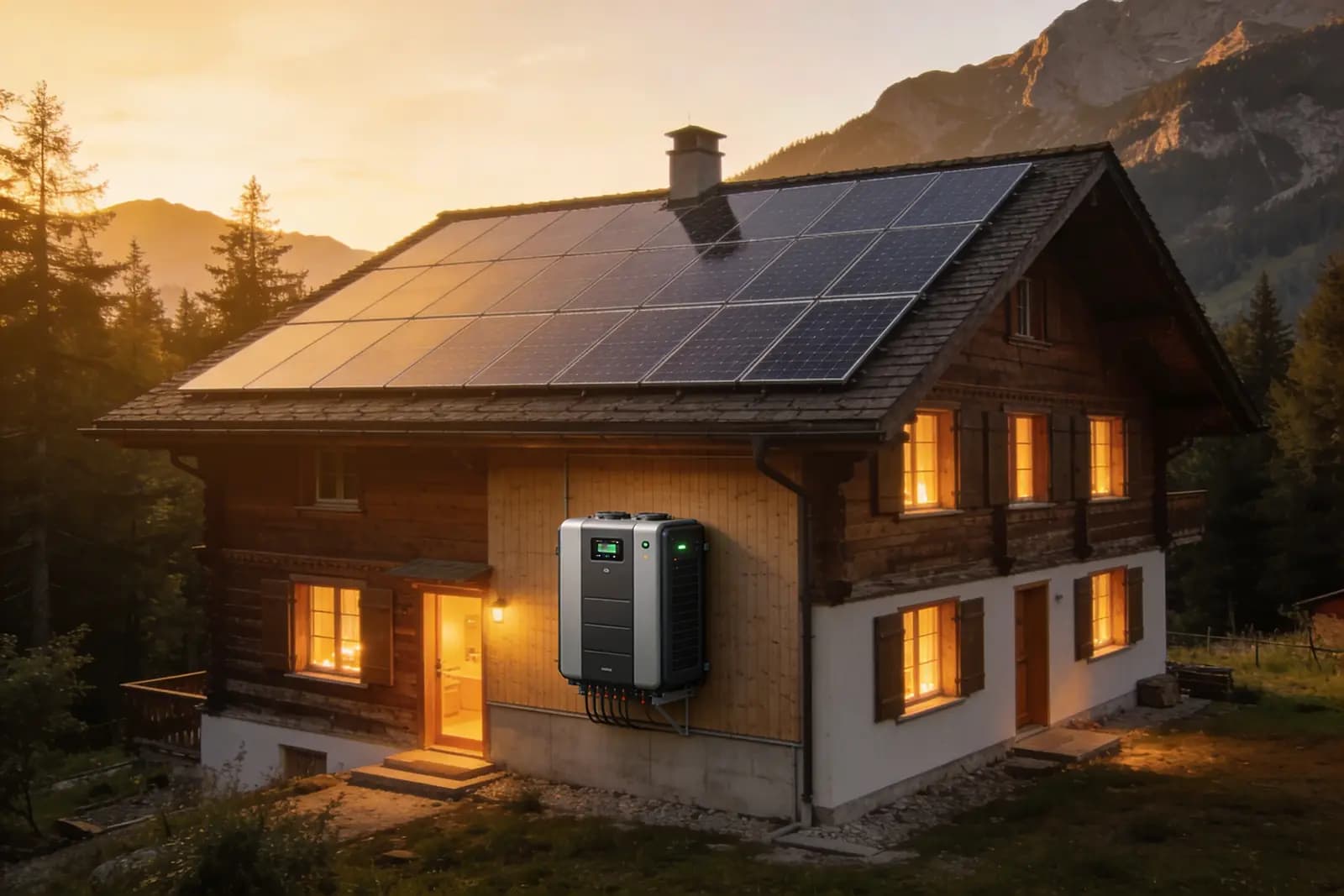
The path to energy independence is built in two stages: first optimize production (panels), then optimize storage and intelligent management (battery + energy manager).
Step 1 — Maximize production: an installation covering 80–100% of your annual consumption is the goal. For 5 500 kWh/year, you need around 8–10 kWp depending on the orientation of the roof. N-Type panels (TOPCon or HJT) are most suitable for mixed east-west roofs thanks to their better behavior under diffused light.
Step 2 — Store smart: A 10–15 kWh battery covers the needs of a typical evening of consumption (18h–7h). Opt for LFP chemistry over NMC for home safety. Brands on the platform include Huawei (LUNA2000), Enphase (IQ Battery) and LG (Home 8 / RESU legacy).
Step 3 — Manage intelligently: an energy manager (Energy Management System) coupled with your EV charging station and your electric cumulus system allows you to automatically optimize your surplus. Huawei and Enphase offer integrated solutions compatible with Swiss standards. The objective is to consume your solar kWh in real time, avoiding both costly network purchases and sales at a loss to the DSO.
Sources & Method
Analysis based on ElCom 2024–2026 data, OFEN (Federal Office of Energy), Pronovo SA, EPFL and HEG Geneva studies. The financial projections use the following assumptions unless otherwise stated: local purchase price, GRD injection price, production 1 100 kWh/kWp/year, self-consumption rate 35–40%. Actual results vary depending on canton, roof orientation and consumption profile. The site may also present its own services or calls for contact related to these subjects.
Next step
Compare several quotes, validate profitability with our tools and then check the contractual conditions adapted to your canton.
No obligation · Transparent data