
The meter is often the invisible part of a solar project. He can modify the measurement, the management and certain invoice lines. Here's what the fifteen minute data actually changes and what it doesn't.
The short answer
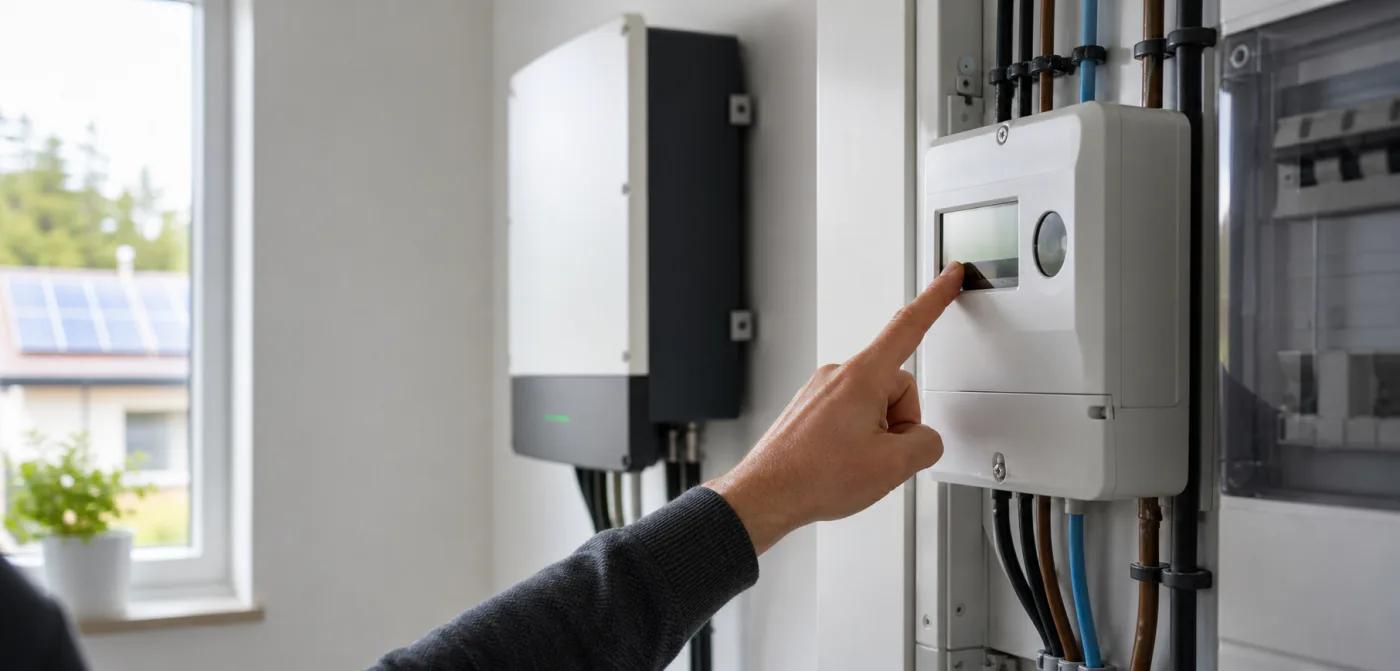
A photovoltaic installation exchanges electricity in two directions. When the house consumes more than it produces, it buys from the network. When the panels produce more, it exports the surplus. A bidirectional meter measures these flows separately so that the DNO can bill the offtake and calculate the recovery. It does not automatically transform the surplus into credit at the full price of the kWh purchased.
An intelligent measurement system provides finer information. ElCom describes measurement in fifteen-minute intervals and plans for a large majority of measuring points in a network area to be equipped with intelligent systems by January 1, 2028, with a margin for functional meters. This data can make self-consumption, peaks and the behavior of a battery visible. It does not change your price by itself.
The bill may include energy, network usage, metering, taxes and other charges. ElCom points out that costs and tariffs are published by each network operator and vary depending on the address. A bidirectional meter can be billed as a measurement cost or as an annual component, but the applicable structure should be read in the DNO tariff sheet.
For a solar owner, the right question is therefore: what flow is measured, to what extent, at what price, with what data accessible and at what cost? The meter must be integrated into the calculation before comparing battery, control, self-consumption and injection.
What a bidirectional meter measures
A bidirectional counter doesn't just look at panel production. It measures the exchange between the building and the network. At any given time, the house can consume 3 kW, the panels produce 5 kW and the network receive 2 kW. The meter must distinguish export from purchase. Later, without sun, the house can buy 3 kW.
This distinction is different from the gross production displayed by the inverter. The inverter may show that the modules produced 5 kW, while the meter only shows 2 kW exported because 3 kW was consumed in the building. To calculate self-consumption, you need both pieces of information or a model that connects them correctly.
The measurement point matters. In a single-family home, the main meter is generally the network reference point. In a PPE, a group or a building with several meters, production, common areas and housing can be measured separately. The diagram should explain which meter belongs to which flow and who receives the bill.
A measurement system can also receive control orders or provide data to a management system. Ask if the meter is only used for billing, if it controls an injection limitation or if it supplies an application. An additional feature may result in a service or subscription that must be included in the offer.
What fifteen minute data brings
Quarter-hour readings show a curve that monthly bills hide. You can see the midday export peak, the heat pump starting, the vehicle charging and returning home. This visibility helps adjust devices and verify a simulation. It can also reveal that a battery is charging at the wrong time or that a house is consuming much more in the evening than expected.
The fifteen minutes does not mean that every device is identified. The meter measures an overall exchange. It doesn't necessarily know if the load is coming from the water heater or the dishwasher. To assign uses, you need sub-meters, inverter data or a detection model. Don't promise device-by-device accuracy with a master meter.
Data is often made available with a delay. An application can display an estimate, a consolidated value or billing data. Ask for update frequency, export format, retention period and the ability to download history. A pretty interface does not guarantee that the history will remain accessible after a change of provider.
The data has operational value. It can help decide if piloting is useful or if the surplus is too low to justify a battery. It can also be used to verify an invoice. For it to be useful, you need to know whether it is measured, estimated, corrected for billing, or provisional.
How to read the invoice
Start by separating the kWh purchased and the kWh injected. The electricity purchased is valued according to the tariff of your DSO or supplier, while the injection is processed according to a tariff or a recovery formula. The two volumes can be indicated in different sections. Don't simply subtract all solar production from annual consumption without looking at hourly flows.
The second step consists of identifying the energy component, the network component, the measurement cost, royalties and taxes. ElCom publishes national median values for 2026, but they are not a universal bill. Network and measurement costs may be higher or lower depending on the municipality and the DSO. Use the local rate sheet and its validity period.
The third step is to check the measurement period. A dynamic rate or time difference can use fifteen minute intervals. If the invoice is still flat rate or monthly, the detailed data can be consulted without changing the price. Don’t assume that a smart meter automatically activates an hourly rate.
Finally, check the role of the meter in the battery or control system contract. If the system uses external data, a subscription may be included for a limited time. Ask what happens after the free period, who supports the connection and if the installation works with another data source.
The cost of the measure
Metering is a network service, not always free equipment supplied with the panels. ElCom says the 2026 tariff may include a separate measurement cost and gives a median annual value for the household profile used in its examples. The amount you pay depends on your DNO, meter type, tariff model and installation.
A bi-directional or smart meter may be required for a new installation, injection or local community. Ask if the change is billed once, if an annual rental applies, if communication is included and if a submeter is the responsibility of the owner. In a PPE, multiple meters and a common production measurement can create multiple cost lines.
Don't choose equipment simply to avoid low measurement cost. The question is the value of the service. If the data helps reduce a peak, avoid an incorrectly sized battery, or correct an order, it may have a higher value. If they remain unused and require a subscription, the profit is lower.
In the calculation, separate the mandatory cost of the DSO, the optional cost of a platform and the cost of a private meter. An installer should not present a software subscription as a network fee. Who is responsible for each cost and the duration of each cost must be written down.
The counter and the injection limit
An injection limit is applied at the connection point, not necessarily to the gross production of the panels. The meter or a sensor placed nearby measures the export and allows the inverter to reduce its power or trigger a consumer. The design must specify the measurement direction, frequency, response to loss of communication and safety setting.
A billing meter may not provide the speed necessary for real-time throttling. A dedicated sensor or gateway may be required. Do not assume that a smart meter installed by the DNO directly controls your inverter. Ask about interfaces and responsibilities.
A position error can distort the calculation. If the sensor only measures production before local consumption, the system risks reducing power that could have been used in the house. If placed too far from the connection point, another flow may be invisible. The drawing and commissioning must show the exact point.
The meter and the battery
A battery needs to know if the house is exporting or buying. It can be set to absorb the surplus, limit injection, charge at low rates or reserve emergency capacity. These objectives may contradict each other. The configuration must therefore specify the priorities and the share of capacity that remains available.
With data per fifteen minutes you can check if the battery is following the curve. But a quarter of an hour is an average or a consolidated value; it doesn't necessarily show every peak second. For a hard technical limit, the command may use a faster measurement. Ask for the exact function.
The battery adds its own data: state of charge, power, cycles, alarms and temperature. Who owns them? Are they accessible after the warranty? A system that only provides proprietary graphics can make it difficult to diagnose or sell the building. Access to data is part of the long-term value.
Data, privacy and change of provider
The fifteen-minute curve can reveal hours of absence, habits and certain uses of housing. Before enabling a platform, ask what data is collected, where it is hosted, how long it is retained and with whom it is shared. The information needed for invoicing is not necessarily the same as that requested by a commercial application.
An owner must be able to give access to the curve without giving their personal password. In a PPE, the data for housing and common areas must be separated. In a local model, participants must know what information is used to bill and what information remains confidential.
Request an export in a readable format and a responsible person when the system crashes. If the app provider disappears or the service is terminated, billing action must continue with the DSO. Solar production should not rely on a private account to remain compliant.
Questions to ask before commissioning
- Does the meter measure purchase, injection and both separately?
- Where is the measuring point in relation to the house, the battery and the inverter?
- Is the data measured, estimated or consolidated before being displayed?
- Are they available every fifteen minutes, with what delay and in what format?
- What measurement cost is invoiced by the DNO, and for what period?
- Is the meter change included in the solar quote?
- Does the limitation system use this meter or a separate sensor?
- What happens if you lose communication or internet?
- What data does the battery use to charge and protect itself?
- Who controls the data and who can export it?
- What happens after a software subscription ends?
- How are the flows distributed in a PPE or a local community?
The answers should appear in the drawing, the offer and the invoice. A purely oral explanation is difficult to verify after commissioning.
A three-month control method
After commissioning, take three representative months: a sunny period, an intermediate period and a low production period. Compare inverter production, metered purchase, export, battery and estimated consumption. The numbers will not be identical because of losses and measurement windows, but the relationships should be explainable.
Look at the export peaks around midday. If production increases but export remains limited, check if the house or battery absorbs the difference. If the system announces very high self-consumption while the meter shows a large purchase in the evening, ask for the definition used. Commercial percentages can be calculated on different bases.
Also compare the invoice lines with the contract. The purchased volume, period, measurement cost and rework must match. If dynamic pricing is enabled, check the pricing intervals and rules. Keep downloaded files, as an app's history may change.
This control is not a legal or metrological expertise. It makes it possible to detect flow confusion, poor configuration or a forgotten cost early. If a difference is significant, write to the DSO and the installer with dates and readings.
What the meter cannot promise
A main meter does not always know which device is consuming. It may show a 2 kW purchase without indicating whether that energy powers a heat pump, an oven, or several small appliances. If the project is based on a specific action, possibly add a sub-meter or equipment information. Without this, the offer must remain cautious on the share allocated to each use.
A reading per fifteen minutes does not necessarily describe spikes of a few seconds. A value can be an average, a maximum value or consolidated data. Ordering a battery and billing can use different logic. Ask what resolution is used for each feature and don't assume that a fifteen minute chart is an instantaneous record.
The meter also does not know the economic value of the kWh. It measures a flow; the contract gives it a price. If the rates change, the same data may have another value without the meter having been modified. This is why the calculation must keep the date of the price sheet and distinguish purchase price, injection price and fixed costs.
Finally, the measure does not automatically improve self-consumption. It makes control possible, but you still need a command, an available device and a suitable setting. A facility that collects a lot of data without acting on flexible charging may cost more without producing additional savings.
An example of an invoice to reconstitute
Suppose that a meter indicates 6 000 kWh purchased over the year and 4 000 kWh injected. The inverter displays 7 000 kWh produced. The building therefore used part of the live production, but the exact figure must be controlled with periods and losses. It would be wrong to subtract 7 000 kWh from the 6 000 kWh purchased and conclude that the bill should be zero: production, purchase and export take place at different times.
On the invoice, check the volume purchased, the price of energy, the network, the measurement and the charges. In the trade-in section, check the volume exported and the price applied. If a measurement cost is annual, do not mix it with the price per kWh. If a dynamic rate appears, ask what time period and rule produced it.
This reconstruction makes it possible to compare a battery with a real base. It also shows whether a promise of self-consumption is based on the production of the inverter or on the exchange actually measured on the network.
Keep this sheet with the data files and the original invoice. It will become the starting point for a future adjustment or rate change.
During a sale or price change
The transition file must contain statements, prices, fifteen-minute data, access to the portal and measurement diagram. The new owner must know what value corresponds to production, purchase or export. A graph without definition can give a bad profitability estimate.
Ask the DNO to confirm the change of ownership and check that the battery or control application does not remain attached to the old email address. Download the historical curve and invoices. On the date you hand over the keys, have the meter reading signed and distinguish the rate periods.
If a battery or dynamic tariff is considered, this data shows the situation before the modernization. They avoid mixing an old measurement period with a new contract.
Data quality over time
A change of counter or platform can create a break in the history. Download the readings before the intervention and note the values at the time of replacement. The new system must specify whether the fifteen minutes are measured, estimated or corrected. Without this information, a comparison of production or self-consumption can mix two definitions.
When making a sale, transmit invoice, price, statements, account data and diagram. The new owner must be able to distinguish the inverter value, the meter value and the value calculated by an application. Change personal access and confirm the holder with the DNO.
If a battery or control uses the curve, request an export without subscription. Billing data must continue even if a business application disappears. A platform should not be the only place where alarms and settings are kept.
When the numbers don't add up
A difference between production and export can come from direct consumption, losses, period shift or estimation. Note date, meter, inverter and weather, then ask what definition explains the discrepancy. A factual message is easier to process than a general accusation.
The meter does not know the price; the tariff gives a value to the flow. If the injection remuneration falls, the measurement remains the same but the calculation changes. So keep the price sheet and its date with the data.
Correct a measurement inconsistency
A difference between production and export can come from direct consumption, losses, shifted period, estimated value or sensor error. Note dates, meter, inverter, weather and price. Ask the DNO and installer what definition explains each value, then keep the answer. Do not open an enclosure or change a metering configuration yourself.
When replacing, have the transition statements signed and save the old history. An invoice may include an estimated period and a validated period; this distinction must remain visible. In a PPE, the correction must also state whether it concerns housing, common areas or production.
The quality of data is not only measured by its number of decimal places. It depends on the position of the sensor, the interval, the correction, the delay and the price definition. These items should be documented before using a curve to purchase a battery.
Conclusion
The bidirectional meter makes a correct solar bill possible; Fifteen minute data makes operation visible. They do not guarantee lower prices or better profitability. The value comes from the separation of flows, verified local rates and management that actually uses information.
Ask for the measurement point, cost, frequency, data format and responsibility of each system. Then check three months of operation. An installation whose flows are measured and understandable is more resistant to changes in tariffs, battery, DSO or owner.
Points to check
- A smart meter provides detailed data, but does not guarantee a dynamic rate or automatic savings.
- Purchase, injection and gross production are different flows which must be separated.
- Measurement costs and tariffs are linked to the DSO and the address.
- A fifteen-minute measurement can be useful for monitoring, but its value depends on its access, timing and definition.