
The 18 November consultation concerns suppliers’ procurement. A worked household example separates remaining purchases, on-site solar use and export income.

The November decision and the next envelope on your doormat
If you are deciding whether to approve a rooftop solar quotation this winter, keep the electricity price printed on your supplier's tariff sheet in the calculation. On 18 November 2026 the Federal Council opened a consultation on how basic suppliers manage electricity purchases and allocate trading results. That announcement supplies neither a new household price nor a new rate for electricity exported from your roof. Someone revising a sales calculation on the strength of the headline alone should be able to identify the published tariff, its period of validity and the part of your consumption to which it applies.
The proposal concerns customers receiving electricity under basic supply in Switzerland. It matters even if a house already produces much of its own annual energy. A family may export on bright afternoons and still buy electricity every winter evening. A change in the energy component of the purchase price affects those imports. Any effect on the profitability of a particular roof depends on when generation replaces a purchase and how the other components of the contract work. You can investigate that exposure today without predicting a future municipal tariff.
Put three dates in the right order
Parliament adopted the underlying legislative change on 2 October 2026. On 18 November the Federal Council opened consultation on the implementing ordinance. The federal announcement gives 29 January 2027 as the consultation deadline and 1 July 2027 as the intended commencement. A consultation deadline is an opportunity to comment on a proposal. It is not the first day of a new billing period. An intended commencement still needs to be checked against the final decision. Record those distinctions beside any spreadsheet assumption that depends on future rules.
Read the Federal Office of Energy's announcement alongside the Federal Chancellery's consultation file. The announcement explains why clarification was sought. The dossier contains the proposed wording and explanatory material. A press summary can tell you what the executive wants to accomplish. It cannot tell you what a named supplier will charge a specific apartment next year. Bookmark the file so that you can replace your note when the final text appears. Write down the date you checked it. A saved link with no date becomes surprisingly hard to interpret when a quotation expires or a second contractor joins the discussion.
What a supply portfolio does
Imagine a local supplier arranging deliveries for the coming year. It expects different requirements on a cold Monday morning, a sunny Sunday lunchtime and a mild September evening. It can buy quantities ahead of time, then adjust positions as forecasts converge on actual demand. If expected demand falls, an earlier purchase may leave a surplus to sell. If a cold spell raises demand, a later purchase may fill a shortfall. A sale in this illustration is an adjustment to procurement. It is a different transaction from a neighbour sending yesterday's surplus photovoltaic production across the street connection.
The draft addresses how procurement strategies and contracts are assigned, how basic supply activities are distinguished from business serving the open market, and how associated gains and losses enter the basic supply calculation. The explanatory question is one of allocation. Which group of customers does a transaction belong to, and has the corresponding revenue or cost been recognised consistently? The federal announcement also describes clearer oversight by ElCom. It gives no percentage by which every bill must fall or rise. A supplier's actual quantities, delivery periods and transactions would matter to any numerical conclusion.
Think of two labelled folders. One holds agreements serving the basic supply portfolio. The other holds agreements serving competitive customers. A receipt for an adjustment belongs with the purchase to which it relates. Moving only the loss into one folder while leaving related proceeds in another would distort any attempt to understand the first folder's costs. This example explains why traceability matters. It does not reproduce a supplier's accounts or prescribe an accounting entry. No homeowner needs access to confidential trading positions to ask which published customer tariff has been used in a solar calculation.
Separate the four pieces of paper
First obtain the tariff sheet for your delivery address, customer category and relevant year. Next find a bill covering a known period, the terms for buying back surplus generation, and the solar quotation with its assumptions. Label the documents separately. The energy seller, distribution operator and company buying surplus may appear under a familiar common brand. Their rates can answer different questions. A logo or a rounded number copied into a brochure is insufficient to identify which document governs an individual line.
On the tariff sheet highlight the charge for energy drawn from the grid. In another colour mark usage-dependent network charges and levies if applicable. Circle fixed amounts billed by day, month or metering point. Note whether figures include value added tax. A cost that stays payable after the installation cannot be credited once for every kilowatt-hour generated. Equally, an energy-only price cannot automatically stand in for all variable purchase costs. Compare either gross with gross or net with net, using the treatment appropriate to the household and the terms displayed. Keep the original headings alongside your transcription so a reviewer can retrace the calculation.
On the buyback terms look for the energy unit, settlement period, effective date and eligibility conditions. Record separately whether guarantees of origin are included, paid separately or outside the agreement. If the written terms leave that question unresolved, show it as unresolved. Avoid treating an indicative example as a guaranteed payment for twenty years. A battery proposal may contain another assumption about avoided purchases at night. Reconstruct what each device changes before adding a second saving to the first.
A small example you can reproduce
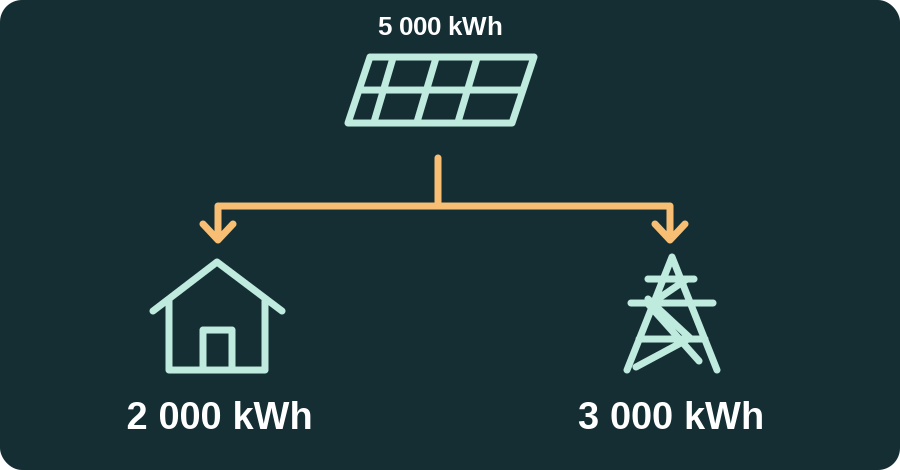
Consider an illustrative household that consumes 6 000 kWh in a year. Its roof produces 5 000 kWh, of which 2 000 kWh serve appliances while generation is available. Ignore storage and losses in this example. The remaining 3 000 kWh leave the building. The household buys 4 000 kWh. Both balances close. Consumption equals on-site use plus imports, and generation equals on-site use plus exports. Neither annual equation reveals the hourly pattern, but each helps uncover an impossible claim before you pay for more detailed modelling.
Assume an avoidable variable purchase price of CHF 0.28 per kWh and an export payment of CHF 0.08 per kWh. These are invented round figures for arithmetic, not tariffs quoted by a Swiss municipality. On-site use avoids CHF 560 in purchases. Exports bring CHF 240. The combined annual benefit before upkeep, financing and tax is CHF 800. A standing charge identical before and after installation cancels out of this comparison. It should still appear in the family's spending budget because the supplier continues to collect it.
Now vary only the avoidable purchase price by two centimes per kWh. The 2 000 kWh used directly change the annual solar benefit by CHF 40. The 4 000 kWh still imported change the household's post-installation purchase bill by CHF 80. These answers differ because the questions differ. Someone multiplying two centimes by the entire roof output would report CHF 100, although exported electricity has retained the original buyback rate in this scenario. Keep the sign of the change visible. A smaller purchase price reduces the value of avoiding imports even while relieving the family's remaining electricity bill.
Try a second variation. Keep all unit prices unchanged and move 300 kWh of consumption from evening to otherwise exporting daytime hours, with sufficient available production. Imports and exports each decrease by 300 kWh. Direct use rises by 300 kWh. The additional benefit is 300 multiplied by the difference between CHF 0.28 and CHF 0.08, giving CHF 60. Washing, charging and water heating are possible flexible loads. Whether any particular household can shift that much depends on its schedule, appliance controls and comfort requirements. Do not assign the full amount to every appliance independently.
Turn a sales claim into an answerable question
Suppose a salesperson says that new federal rules make the investment pay back a year sooner. Ask for the line that changed between yesterday's estimate and today's version. Is it generation, the share consumed immediately, the energy purchase price, the network component or export remuneration? Ask them to keep the other quantities fixed on a comparison sheet. If several rows changed, request intermediate totals. A conclusion that survives this exercise can be discussed on its merits. A claim with no identifiable input is unsuitable as a reason to sign before an advertised deadline.
A building with separate tenants and common services needs a slightly different exercise. Determine who receives each bill and which loads actually sit behind the connection used in the estimate. A landlord paying for staircase lighting cannot routinely credit all electricity consumed in privately metered kitchens to that same account. An owners' association might have a collectively billed lift and ventilation system alongside separately supplied dwellings. Draw the boundary around the actual project perimeter, name the contracting party and reconcile annual totals against that perimeter. Handwritten boxes on a floor plan are adequate if everyone agrees what the boxes represent.
A family planning a heat pump should request a winter profile as well as an annual estimate. A November change in procurement policy does not move sunshine from July into January. If the heat pump adds substantial demand after sunset, those purchases remain exposed to the actual applicable tariff. A future electric vehicle can increase flexible demand if the vehicle is usually parked at home during generation. A commuter who leaves before sunrise and returns after dark faces a different opportunity from a retired neighbour using the same model. Use actual departures, seasonal absences and charging constraints, then describe any behavioural assumption openly.
Audit an offer without disclosing your household routine
Send the installer a suitable aggregate or anonymised extract when possible. Remove customer references, bank details and personal identifiers from examples circulating among several bidders. Interval readings can reveal a surprisingly detailed occupancy pattern. Explain the intended use and ask which period is required before sending a complete export. A monthly import total can be enough to detect a gross mismatch, although a defensible estimate of simultaneous production and demand generally benefits from finer detail. Label a simplified first pass accordingly and save the fuller investigation for decisions large enough to justify it.
In a shared folder give each input a plain description, unit and source. Keep the original quotation immutable. Make a dated copy for experimenting with scenarios. Add columns for confirmed, assumed and pending values. If a price concerns another commune, another customer group or a different year, place it in the comparison notes. Avoid letting it become the default through an unnoticed spreadsheet reference. One useful cross-check is to ask a second person to reproduce the annual benefit with a pocket calculator and only the four source documents. Any unexplained difference deserves attention before comparing suppliers.
Read a bill across a change of period
A bill may span weeks belonging to different tariff periods. Check the dates and any split shown by the supplier before multiplying a yearly unit price by the full quantity. Distinguish an instalment request from a final settlement. A payment collected in November can concern a period beginning in summer. A later adjustment may include earlier advances, a credit carried forward or a corrected reading. None of those entries alone proves that procurement costs have changed. Lay the old statement and new statement side by side and match the service periods first.
For a meter replacement, check the identifiers and final and starting indices. A different serial number can explain an apparent discontinuity that a policy headline cannot explain. For a tenancy change, mark the handover date and the party responsible before and after it. For a billing error, contact the issuer with the specific disputed line, unit and period. Retain the response and updated calculation together. For a general question about the consultation, use the federal dossier. Addressing the right institution speeds up both conversations and protects you against mistaking an individual correction for a nationwide policy decision.
A procurement headline is a poor battery-sizing method
A storage offer should say how much usable energy can be shifted, how often the opportunity occurs, and what losses apply. Charge and discharge power constrain which peaks can be served. Capacity limits how much energy survives from afternoon to evening. Replacement assumptions, installation cost and maintenance all affect economics. Ask for one baseline with no battery and a second with the battery installed behind the same meter. Keep panel count, weather series, occupation schedule and tariff definitions identical. Otherwise a difference attributed to storage may come from other changes between the two runs.
For example, excess output during a holiday week has little immediate household demand to meet. A small battery may fill early and then leave most subsequent surplus available for export. Conversely, a foggy winter week can leave little surplus to store at all. A single best summer day exaggerates the annual opportunity. Request monthly imported, exported and directly consumed quantities and review the winter and summer limits together. If a future tariff is essential to the financial case, show a break-even threshold alongside today's result and identify the publication that could eventually justify replacing the assumption.
Keep a decision record that will age well
Write one sentence summarising the federal development, a second stating what remains open, and a third naming your next action. For example, an owner can ask the installer for a sensitivity calculation using today's documented purchase and export prices. A co-owner can put the common-meter boundary on the agenda before approving a collective estimate. A tenant can ask which bill or settlement would show a promised saving. A small shop can confirm its actual supply arrangement before borrowing an illustration intended for residential basic supply. Each action remains useful regardless of the final ordinance wording.
Before signing, check that you can locate the tariff sheet, identify whether fixed charges survive, trace exported electricity to a written offer, explain the on-site allocation and reproduce the illustrative annual benefit. Photograph or save the version of the quote you accepted. Set a reminder to revisit the official file after consultation closes and to refresh the calculation when the supplier publishes applicable prices. Make the investment decision using your roof, usage and contracts. Keep a visible margin for changes whose direction and magnitude are still unknown.