
Plug and play solar attracts tenants and co-owners who cannot equip an entire roof. Here are the practical rules, safety questions and honest calculation of a small balcony system in Switzerland.
The short answer
A balcony solar system may be relevant for an apartment that has a well-exposed balcony, safe access to a suitable outlet and an occupant who uses electricity during the day. It can reduce electricity purchases by directly supplying the home, but its production remains limited by the surface area, orientation, shadows and authorized power. This is not a mini roof installation that would offer the same savings in a smaller format.
Caution begins with the power injected. Swissolar indicates that plug and play systems are generally authorized in Switzerland within a simplified framework, with a maximum connection or injection power of 600 W and written notification to the energy supplier before commissioning. The exact terms and documents requested must be confirmed by the network manager of your address. Purchasing a kit online does not replace this approach.
It is also necessary to separate administrative authorization from electrical safety. A balcony can physically accept a panel while presenting a risk of falling, overloading the guardrail, being torn away in the wind or poor connection. The rules of management, lease, PPE and municipality can add conditions. A safe solution is one that remains stable in bad weather, does not create accessible cables or overloaded sockets and has a declaration of conformity available.
The right decision is therefore made in four steps: check the right to install, check the connection, estimate the production on your balcony and compare this production with your current consumption. If you have to buy a battery to use the energy produced by a small panel, recalculating the whole thing is essential.
Why are balcony kits so interesting?
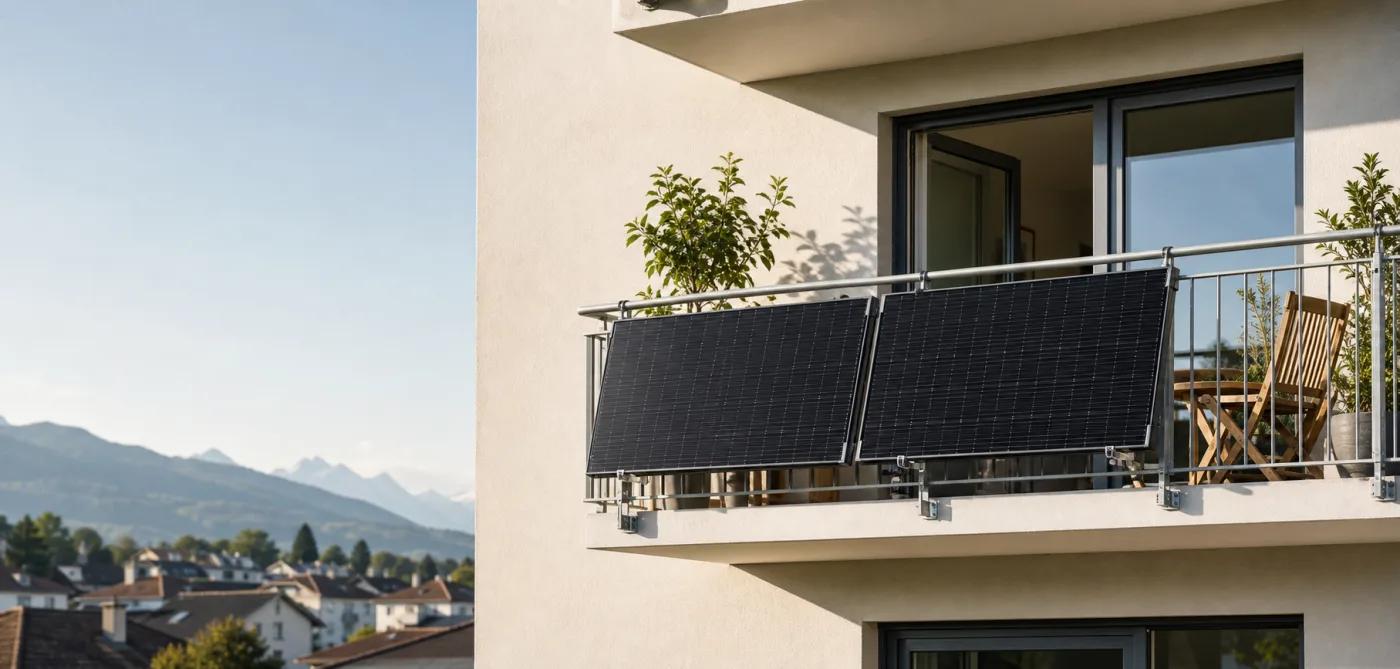
A complete roof installation requires an owner, an available surface area, a quote, possible authorization, a connection and a significant investment. A tenant or co-owner may not have any of these levers. The balcony sometimes offers a more accessible point of support: two modules, a fixing structure and a connection to the home circuit.
The small format also allows you to learn your consumption. A person who follows production and uses quickly discovers that solar electricity is not unlimited credit injected into the socket. It is available especially when the sun hits the modules. The operating refrigerator, router, fan, computer or small appliance may use current; an empty house does not automatically consume it.
However, the market contains very different products. Some kits are designed for permanent attachment and declaration to the network. Others rely on mobile supports. The presence of a cable with plug does not mean that any socket is suitable. Ask for power output, internal protections, certificates, commissioning procedure, wind resistance and liability in case of damage.
The word “plug and play” describes a simplified installation, not an absence of rules. The seller must be able to provide a technical file in understandable French or German, a diagram, a declaration of conformity and a clear procedure for notification. If the product sheet does not mention Switzerland, GRD or electrical protection, do not assume that the kit is compatible.
The power of 600 W: how to understand it
The frequently cited limit of 600 W concerns the connection or injection power within the simplified framework mentioned by Swissolar. It does not transform the system into a constant 600 W source. Two panels can display higher peak power while having a limited inverter, but it is the entire configuration that must comply with the framework. You must therefore look at the AC power of the inverter, the number of modules, the connector and the declaration, not just the total in watts written on the box.
A 600W system produces less than 600W much of the time. In summer, a south balcony without shade can reach peaks close to its limit for a few hours. In winter, low sun, snow and short days greatly reduce production. A realistic estimate should show an annual range and explain the assumptions. Swissolar quotes, for this type of solution, an order of magnitude of around 200 to 800 kWh per year depending on the site and the installation. This is not a guarantee for every balcony.
The figure to compare is not just production. If the home consumes 0,2 kW permanently with refrigerator, router and appliances on standby, part of the surplus is absorbed. If the occupant is absent and turns off all the devices during solar hours, the energy actually recovered will be lower. An energy meter or kit data can help observe the profile after commissioning, but does not promise equal savings for each kWh produced.
Authorization from the lessor, management or PPE
A tenant should request written consent from the lessor or management before ordering the equipment. The application must show the type of fastening, weight, position, cable routing, absence of unauthorized drilling, removal conditions and insurance. An annotated photo of the balcony and a short technical sheet make the answer easier. The oral agreement of a neighbor does not protect the lease contract.
In multi-storey ownership, the exterior of the balcony, the facade and the guardrail may fall under the common area or a PPE regulation. The owner must consult the regulations and request the required decision. Swissolar recommends checking the PPE procedure; depending on the project, a qualified majority, unanimity or another rule may apply. Do not attach a sign to a common facade assuming your share allows you to do so.
The aesthetic requirements are sometimes reasonable: discreet location, color of the structure, absence of glare, removal in the event of work. They should not be ignored, but they should be distinguished from a vague refusal. If the project is blocked, ask for the contractual basis and the solution that would make the installation acceptable. The objective is to produce electricity without creating a lasting conflict with the building.
Mechanical safety on a balcony
Wind is the first underestimated risk. A balcony panel has a surface that can act as a sail. An attachment intended for a metal railing is not necessarily suitable for a glass railing, a wooden balustrade or a balcony which receives gusts channeled between buildings. The seller or installer must specify the compatible system, the admissible weight, the tightening torques and the advertised resistance.
The sign must not be able to fall onto a person, a street, a lower terrace or an escape route. Use secondary fasteners if the manufacturer provides them, check them after the first bad weather and respect the prohibition on modifying the module frame. Do not drill a panel to add a rope or hook. The safety solution should be designed for the load, not improvised with a string or cable tie.
Also think about water, snow and heat. A cable that lies in a puddle, rubs against an edge or gets pinched by a door can become damaged. An exposed connector must be provided for the exterior and remain accessible for inspection. The panel can become very hot behind glass; the manufacturer must specify clearances and ventilation. A safe structure follows the module and fixing instructions at the same time.
Electrical safety and socket
A balcony socket is not automatically a suitable connection point. The circuit can be shared with other consumers, protected by a sensitive circuit breaker or power an external socket with special conditions. Swissolar particularly emphasizes the importance of type B differential protection or equivalent all-current protection when the configuration of the inverter requires it. The verification must be carried out using the exact equipment and by a competent person.
Do not use a power strip, long indoor extension cord or adapter not intended for outdoor use. Do not plug two systems into the same outlet to artificially increase power. Connectors must be compatible and locked; cables must not remain in a passage area. If the kit requires a modification of the panel, new protection or an insulation measure, this must be carried out by the competent electrician.
The kit sheet must indicate the power, maximum current, protections, earthing, protection class, behavior in the event of network loss and applicable certificates. The inverter must disconnect in the event of a grid outage; a kit plugged into a socket should not power an isolated installation with the intention of creating a backup system. Balcony power does not replace a backup inverter and network separation.
The meter and notification to the DSO
Before commissioning, send the written notification requested by the supplier or network operator. Keep the date sent, the response, the inverter model and the declared power. If the DSO requests a bidirectional meter, intervention may be necessary. Don't take no response as unlimited permission: retry with the missing information.
The existing meter may only measure a net flow. In this case, the energy exported at a time reduces the energy purchased, but the household should not imagine that it receives a separate remuneration for each kWh. The DSO contract and the meter determine the measurement and the price. A small installation is primarily interesting for the energy consumed in the home, not for a resale strategy.
A smart meter can make the data more useful, but it is not essential for the installation to work in all cases. Ask what metering fees apply, who changes the meter and how the data is accessed. Measurement rates are local; include them in the calculation if replacement is necessary.
How to calculate real profitability
The calculation begins with the complete cost: modules, micro-inverter or inverter, fixing, cables, protections, delivery, notification, possible electrical intervention and management agreement. A sticker price of CHF 500 may exclude heavy-duty mounting, external socket, new protection or shipping costs. Compare offers that contain the same elements.
In terms of savings, multiply the actual self-consumed production by the price of the kWh that you avoid purchasing. An exported production can have a different value, sometimes zero in the conservative calculation. Do not automatically put the full household rate on all production. For an apartment, the dead load is an important factor; the small system can be more profitable in an occupied home than in a second home.
Take three scenarios. In the conservative scenario, shadows and absences reduce production and only a modest portion is consumed. In the central scenario, you use actual orientation and presence data. In the favorable scenario, the balcony is clear and a device operates during the day. Add maintenance, possible replacement of the microinverter and the cost of removal if you move.
A balcony battery can increase self-consumption, but it adds price, losses, weight, safety requirements and a component that can fail. Capacity must correspond to daily production and evening consumption. If the kit produces 1,5 kWh one day and the home consumes 1 kWh in the evening, a 5 kWh battery does not automatically bring more value.
When the solar balcony is not the best option
A north-facing balcony, shaded by a neighboring building or subject to a fixing ban may produce too little to justify the cost and risk. A tenant who is moving in six months must include dismantling and the possibility of leaving the equipment in the accommodation. A PEP that requires a formal decision can make the timeline longer than a simple online order.
If you own a house with an available roof, compare the kit with a complete photovoltaic study. The roof can offer more kWp, better visibility of production and cleaner electrical integration. Installing a balcony remains interesting as a first step or for an apartment, but it should not be presented as a universal substitute.
The small system can also be a good educational tool. It gives an idea of the seasons, the orientation and the behavior of the devices. But the experience must remain controlled. Do not remove the protections, do not modify the inverter or attempt to connect the kit to a common circuit without validation.
Questions to ask the seller
- What is the AC output power and what power is declared to the DSO?
- Is the product intended for residential connection in Switzerland and what documents prove this?
- Which fixing is suitable for my guardrail, with what weight and what wind resistance?
- Who is responsible if the balcony, facade or panel is damaged?
- Is notification to the DNO included or do I have to do it myself?
- Does the kit require a bidirectional meter, a dedicated socket or specific differential protection?
- How does the inverter behave during a grid outage?
- What annual production is estimated for my orientation and my shadows, and with what method?
- Are the cables and connectors intended for outdoor use and can they be inspected?
- What happens in the event of moving, termination of lease or withdrawal requested by the PPE?
A serious seller agrees to answer these questions before payment. Be wary of offers that only use the power of the modules and a maximum annual yield without taking into account your balcony.
Checklist before purchasing
Photograph the balcony at several o'clock positions and note the shadows. Measure the space, identify the material of the guardrail and check the management or PPE regulations. Obtain written approval before installing. Look for the name of the DNO on your invoice and use its notification procedure.
Then, ask for a complete power sheet, the connection diagram, the declaration of conformity, the fixing instructions and the necessary protections. Have the outlet and circuit checked if the seller recommends service. No price advantage justifies an improvised connection.
Finally, calculate self-consumed production by distinguishing between hours of absence. Don't reflexively put a battery in the budget. If the financial return is long, also evaluate the non-financial value: reduction in consumption, learning, interest in the building and possibility of moving the kit during a move.
Also plan an inspection after the first wind episode and after winter. Check that the clips have not moved, that the cables are not rubbing and that the connectors remain dry. A small, well-maintained facility retains its interest; an installation where no one controls the fixing can become a problem for the entire building.
After the first season
A balcony kit must be checked after its first episode of wind, after prolonged rain and after winter. Check that the fasteners have not moved, that the panel does not touch the railing, that the cables do not rub and that the connectors remain dry. If a vibration, inclination or trace of heating appears, interrupt use of the area and request a competent check.
Compare production with the announced direction, but do not conclude too quickly that there is a breakdown. A balcony may receive shade at a different time depending on the season and the low sun may be hidden by a building. Note the weather conditions, presence of occupants and background consumption. These observations are better than a comparison with the maximum performance of a website.
Review the connection question. The socket must remain accessible, dry and without signs of heating. No adapters need to be added to increase power. If management or the DNO requests a modification, have it carried out according to the instructions and keep the proof.
Insurance, moving and continuity
Ask the insurance company if the system, fixing, facade and damage to third parties are covered. The owner of the kit can be the tenant, while the guardrail belongs to the building. This separation must be understood before an incident. Also notify management when facade or balcony work is announced.
In the event of a move, the agreement, declaration and fixation are not automatically transferred to a new address. Photograph the disassembly, return the balcony to its intended condition and check the new railing before reinstalling. A kit that is safe on one balcony may be unsuitable on another.
Keep data, invoice, warranty, declaration, diagram and photos in a file independent of the seller. If the gate disappears, you still need to know the power, model, date and security procedure. This documentation increases the practical value of the system and protects other occupants of the building.
Owner control
Once a season, check the mounting, cables, connectors, condition of the socket and the presence of new shadows. Note production and incidents in the same file as the invoice and management agreement. A kit that changes ownership or balcony must be accompanied by this information.
Don't let an app decide security on its own. The owner must know the switch, the shutdown procedure and who to call. If an electrical fault, infiltration or deformation is visible, the gain of a few kWh does not justify continuing to use the system without checking.
Withdrawal is also part of the decision. A balcony may need to be released for work, a lease may end or PPE regulations may change. Ask who pays for the dismantling, how the facade is restored and whether the fixture can be reused at another address.
Conclusion
Balcony solar can be a useful little decision, as long as you treat it like an electrical installation attached to a building, not a gadget. Network notification, management agreement, wind resistance, differential protection and behavior in the event of an outage are as important as the number of watts on the packaging.
For profitability, start from your actual balcony and your actual consumption. A smaller but well-oriented system, securely mounted and used during the day may be more relevant than a more powerful kit installed in the shade. If you cannot answer the question “who checks what and with what document?” ”, wait before connecting.
Points to check
- The simplified power and notification procedure must be confirmed with the DSO of the address.
- The agreement of the lessor, management or PPE is separate from the electrical notification.
- Suitable grip, fixation and protection are necessary; a plug with socket does not exempt you from checking the circuit.
- The annual production depends on the actual balcony and cannot be guaranteed by the number of watts of the modules alone.