
The 18 November contingency measures are inactive. Check connection documents, responsibilities and the functions in a proposed solar resilience upgrade.

What the 18 November announcement changes for a solar household
Keep the approved operating settings of your rooftop installation and check the source of any instruction asking you to change them. On 18 November 2026, the Federal Council reviewed updated preparations for supplying electricity during a severe shortage. The announcement describes contingency instruments. Its published assessment says electricity supply is secured and the measures are inactive. A homeowner can use this development to organise documents, identify the responsible contacts and examine a proposed resilience upgrade calmly.
The Federal Office of Energy announcement describes two prepared instruments covering reserve power stations and central management of electricity supply. The latter would involve generating plants rated at least ten megawatts, with batteries outside the central management described. Activation would require a Federal Council decision adapted to the actual situation. These boundaries describe the published preparation as checked on 21 November. They provide a reference for evaluating a sales message that claims a house must immediately receive new equipment.
For a Swiss owner considering solar panels, the useful question is how the announcement relates to the connection agreement, normal household operation and the particular functions being offered. Write those three matters on separate lines in your project file. An installer should be able to attach a relevant document and a concrete explanation to each proposed change. A national announcement alone supplies neither a household equipment specification nor a quotation for work on your property.
Read the date and the responsible authority together
The announcement is dated 18 November. The ElCom supply assessment available during our check is dated 17 November. Keep both dates with your notes. A later article discussing an older assessment has a different information history from a newly issued operational instruction. When forwarding a message to relatives or a co-owner, preserve the original link, the issuing organisation and the date displayed on the source.
Suppose a supplier sends an email on Friday saying that all batteries must be charged to a new minimum because of the federal announcement. Ask for the contractual or official basis, the exact equipment affected, the proposed start time and the consequences for the customer. Request the answer in writing before approving paid changes. This approach also helps when a legitimate installer is explaining a separate grid connection requirement that happens to arrive during the same week.
Create a short contact sheet containing your distribution operator, its incident reporting route, your installer, the battery manufacturer and the person who administers monitoring access. Identify who owns the electricity contract if the building contains several flats. A landlord, owners' association and individual occupier can receive different messages. Recording who can authorise a service visit prevents a technical question from becoming an avoidable administrative delay.
Distinguish the national energy balance from an interruption at home
A shortage concerns the availability of sufficient energy over a period. A local interruption concerns the electricity reaching a particular connection. The two situations require different observations. If an app stops updating while the lights and appliances operate normally, start with its timestamp and communications. If the property loses supply, use the distribution operator's incident information and the installation's documented operating procedure.
The site's guide to solar during an electricity interruption explains the equipment question in detail. For this announcement, a household should establish its actual configuration before asking what a national contingency plan might mean. The commissioning folder can identify a grid connected inverter, storage unit, changeover equipment and any circuits intended to receive backup supply. Ask the installer to resolve missing or contradictory labels.
In a shared building, check whether the central heating controls, entrance system, lift, common lighting and internet equipment use the same connection as your flat. A resident's domestic battery proposal might leave all those shared services outside its intended scope. Use the building's existing plans and the property manager's records. The result is a useful description of responsibilities even when no change to the installation is planned.
Put the power ratings on the correct scale
The official document uses a 10 MW threshold for the central management it describes. Ten megawatts equals 10 000 kilowatts. A household file might describe 12 kWp of modules and an inverter with a 10 kW alternating current rating. Record the module rating and inverter output separately, because they refer to different parts of the equipment. When an instruction concerns a specified plant category, ask which documented rating the issuer uses.
These illustrative figures help a reader understand scale. They do not replace the definitions of an activated ordinance, a connection contract or a site specific instruction. A farm, workshop or property complex may contain several generation units, several meters and a commercial contract. Its manager should use the complete electrical inventory rather than select the smallest number printed on an individual device.
Make a simple inventory with one line per inverter, meter and storage unit. Include the model, serial number, owner, accessible manual and commissioning date. Photograph labels only where they can be read safely from a normal position. Keep installation diagrams with the original documents. If an equipment list is already available from handover, update that existing list so that an installer receives one coherent version.
Translate a resilience proposal into named services
Ask a contractor to describe what will work during the specific event you want to address. A proposal can identify lighting in two rooms, a refrigerator, a communications device and a small circulation pump. Record each load's running power, operating hours and any starting requirement supplied by its manufacturer. The household can then judge whether the offer covers the service it values.
Swissolar's explanation of solar during a grid failure describes conventional grid connected operation, suitable island operation and the importance of the complete system configuration. Use that explanation to prepare questions about changeover, the supported circuits and solar recharging. The installer should confirm these functions for the models and wiring in your quotation. A product name containing the word hybrid leaves several of these decisions open.
For an existing installation, ask whether the proposed work changes the distribution board, protection devices, monitoring, warranty conditions or arrangements with the grid operator. An offer should name the responsible professional and the documentation delivered afterwards. Agree how the commissioned functions will be demonstrated. The demonstration can follow the manufacturer's procedure under the installer's control, with the outcome recorded in the handover report.
Calculate a small energy budget before choosing capacity
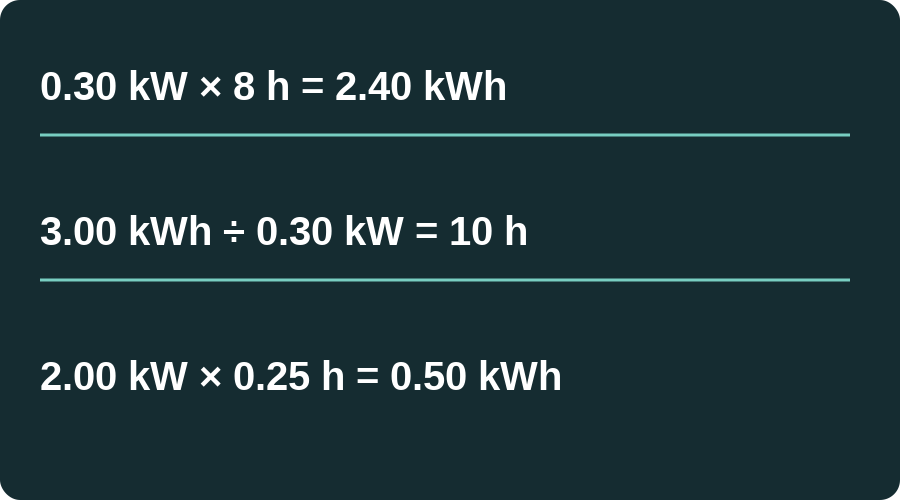
Consider an illustrative group of priority appliances averaging 0.30 kW. Over eight hours, the energy requirement is 0.30 kW multiplied by 8 h, or 2.40 kWh. Suppose an installer estimates that 3.00 kWh can actually reach those circuits after the chosen reserve and losses. The same constant load would have a theoretical duration of 3.00 divided by 0.30, or ten hours. Both inputs need confirmation for the proposed system.
Now add a 2 kW appliance for fifteen minutes. That single use requires 0.50 kWh and also raises the instantaneous power demand. The first calculation concerns energy, while the second question concerns what the inverter and backed up circuits can deliver simultaneously. Keep those checks visible in the quotation. A large nominal battery capacity can coexist with a lower output limit or a limited set of connected circuits.
Write down the operating assumptions alongside the arithmetic. Refrigerator cycling, a pump starting, ambient temperature, battery state of charge and available sunshine can alter the outcome. These examples describe a planning exercise rather than a promised duration. A household that needs continuity for a critical personal service should have the responsible equipment specialist determine the appropriate continuity arrangement and required testing.
Compare expenditure with the problem being solved
A resilience improvement and an annual electricity saving can share equipment while serving different objectives. Request separate descriptions of the extra functionality, the annual operating assumptions and the additional installed cost. Include accessories, electrical work, commissioning, ongoing subscriptions and maintenance that the proposal requires. A low price for the battery alone leaves several decisions unpriced.
For example, two offers may use the same storage capacity while one supplies only a designated outlet and the other supports a defined group of circuits through an appropriate changeover arrangement. Compare the delivered functions and the documented limitations. Ask whether a future inverter replacement will preserve the intended arrangement. The battery sizing guide helps connect the storage discussion to measured household consumption.
Keep your ordinary solar calculation anchored in the applicable tariffs and expected production. The national contingency announcement does not provide those project inputs. If a proposal uses a substantial price increase as its principal justification, ask for the source, period and sensitivity calculation. You can then see how a different assumption changes the estimated saving, independently of the value you assign to continuity.
Keep a short household action plan
Start with information that can be assembled without altering equipment. Save the original federal announcement, the current operator contact details, the installation inventory and the operating instructions. Identify a person who can retrieve them if the usual account holder is away. Keep a local copy of essential documents that can be opened without relying on the solar monitoring portal.
Discuss the practical needs with the people who occupy the building. Agree which ordinary activities can be deferred, which appliances require attention and who contacts the property manager. A freezer, home office and communal heating system raise different questions. Record those priorities in familiar language so that the plan remains usable by someone who did not attend the installation appointment.
If an official measure is activated later, read its actual scope, effective date and instructions at that time. The BWL document collection brings together the published preparation materials. Keep the link with your plan and verify the latest version when a decision is needed. The relevant instruction can then be compared with your documented equipment and contractual responsibilities.
Include a workshop or shared premises in the conversation
A household that also runs a small business can prepare a more informative inventory by noting where domestic and professional activities meet. A garage workshop, refrigerated stockroom, booking terminal or remotely operated entrance may have a different owner, insurance arrangement and service contact. List those dependencies with the equipment, the person responsible and the minimum information needed to resume ordinary activity after an interruption.
For a co-owned property, send the relevant question through the existing property management process. The committee may already have a maintenance appointment, an electrical survey or a contract that covers the common areas. Combining requests can avoid duplicate quotations and conflicting assumptions. Ask the professional to identify which shared facilities are included in the assessment and which require the operator's separate participation.
Make the practical acceptance criteria observable. A quotation can specify a named circuit schedule, an updated diagram, a demonstration report and an explanation accessible to the designated caretaker. Record how a replacement component would be selected if the original product becomes unavailable. These questions concern the longevity of the proposed solution and help owners judge the service promised beyond the initial equipment delivery.
Prepare a useful request for your installer
Send a focused request with the property address, system models and the exact question raised by the announcement. Attach the relevant page of the existing handover record and the proposed work, if any. Ask which technical function or contractual requirement the contractor is addressing. Include the appliances you want supported and the duration you used in your example, with permission for the specialist to correct those assumptions.
An informative response should describe the current arrangement, the proposed result, any approvals required and the evidence supplied at completion. It should also identify what would require a separate decision by the operator or property manager. Keep that response with the offer. This turns a general news item into an answerable project question and makes later comparisons much easier.
For a property that is still choosing an installer, include access to manuals, monitoring ownership, after sales contacts and documentation in the comparison. These items remain useful throughout the installation's working life. Our handover document guide describes the records a homeowner can request. The aim is to have a system whose actual capabilities can be explained using its own approved documents.
Finish the check with a recorded decision
Your decision note can fit on one page. Record the date checked, the official source consulted, the configuration confirmed and any unanswered questions. State whether you are keeping ordinary operation, asking for documentation, commissioning a specialist assessment or comparing a specific upgrade. Assign a person and a realistic follow up date to each outstanding action.
Review the note when the household changes equipment or receives a relevant operator instruction. Adding a heat pump, charging point, commercial tenant or second battery can change the assumptions used in an older assessment. Retaining the original calculation and the reason for each update helps the next professional understand the project. That documentation is a practical outcome of the November announcement, even for a house that continues its ordinary solar operation.