
Reconcile the period, meter, exported quantity, price and guarantees of origin. A worked example supports a documented correction enquiry.

Start with the electricity actually credited
To check a solar export credit, connect a settlement period, an exported quantity and the applicable price. The inverter's production total is not automatically the quantity sold: some electricity may have been used inside the building. Before challenging a disappointing payment, reconstruct its individual lines. This guide concerns an owner with a grid-connected installation and an electricity purchase agreement. Shared-energy projects and special support arrangements may require a different reconciliation and additional records.
Collect the agreement, tariff appendix, network operator's readings, invoice or credit note and any separate arrangement for guarantees of origin. Our export tariff guide explains the general remuneration principles. The question here is practical: establish how a particular payment was built, locate a possible discrepancy and present a clear correction request. A manufacturer's dashboard can help investigations, but its graph alone does not prove a billing error or establish the amount that the purchaser should pay.
Match the paperwork to the measurement point
Check the address, account holder, installation reference and measurement-point identifier. A customer account may cover several properties, whereas a settlement concerns one meter. A house sale, company-name change or system extension can leave outdated information in correspondence. Start with these details before comparing fractions of a franc. If you are reviewing the wrong measurement point, otherwise accurate arithmetic will produce an irrelevant result and send the enquiry to the wrong department.
Photograph only safely accessible information without removing covers or opening equipment. Record the observation date and retain earlier documents if the meter has been replaced. Ask the operator to connect old and new identifiers and provide the transition readings. A cumulative series that restarts at a different value after replacement cannot be subtracted as though the same device remained installed throughout. Keep the explanation alongside the records so that future comparisons do not repeat the same avoidable mistake.
Align dates before comparing totals
Write down the settlement's beginning and end, followed by the boundaries of the data you intend to use. A calendar-month screenshot cannot be compared directly with an invoice covering different dates. An application may display a rolling year, while the official statement covers a quarter or partial period. Do not divide annual production into equal seasonal shares: sunshine, household demand and equipment availability vary across the year, making that shortcut unreliable for checking an individual credit.
For detailed exports, ask about time conventions, interval boundaries and daylight-saving changes. Keep original files untouched before importing them into a spreadsheet. Add a note describing transformations such as unit conversion and date selection. Missing, estimated and corrected observations should remain identifiable. A transparent reconciliation is preferable to a perfectly balanced workbook whose hidden edits have erased the evidence needed to explain how the result was reached or to discuss it with the organisation responsible for settlement.
Distinguish generation, imports and exports
The inverter measures production at one part of the system; the network meter measures exchanges at another. Self-consumption, batteries, losses and measurement boundaries can explain differences. Ask the professional for the relevant installation diagram. Simple subtraction can illustrate an uncomplicated system without storage, but it is not a universal method for every battery architecture, converter arrangement or shared building. Identify what each series actually measures before giving two similarly named totals the same meaning.
As a deliberately simplified illustration, suppose generation is 2400 kWh, direct use is 900 and exports are 1500 over matching boundaries, without a battery or losses in this model. Export remuneration relates to the 1500 kWh, rather than all 2400. The 900 help avoid purchases under the household's own conditions. These quantities predict nothing about a real roof. They explain why the payment cannot be inferred from a manufacturer's production total without knowing how much electricity reached the settlement boundary.
Read the price with its unit attached
Identify whether a price is expressed in francs per kilowatt-hour, centimes per kilowatt-hour or francs per megawatt-hour. Confusing francs with centimes changes the result by a factor of one hundred. Converting a figure per megawatt-hour to one per kilowatt-hour involves a factor of one thousand. Put units in every column heading and retain sufficient decimal places during intermediate calculations before applying the rounding convention actually used on the statement.
Where an agreement distinguishes periods or products, keep separate rows instead of immediately calculating an average. A simple average without the corresponding quantities may be misleading. Check whether the quoted rate includes another component, such as ecological value. The price of exported energy, the retail price of imported household electricity and the overall amount of an electricity bill are not interchangeable. They can appear on documents from the same organisation while paying for different flows, services or accounting adjustments.
Identify the reference governing this payment
The SFOE reference-market-price page explains the mechanism applicable since the beginning of 2026 when a network operator and producer do not agree on remuneration. That does not justify automatically replacing an agreed contractual price with a national value found online. First ask which agreement, period and remuneration rule support the payment you received. Then check the cited reference, its publication date and its relevance to the installation and settlement in question.
The official page schedules publication for the fourth quarter of 2026 in the following January, subject to a data-quality reservation. On twenty-six November, that quarter has not finished. A credit received during November might concern an earlier period, an advance or a particular agreement; ask the issuer to identify it. Do not invent a final quarterly rate from a daily market quotation or commercial forecast. Keep future arrangements separate from the conditions used to settle electricity already delivered during an earlier period.
Recalculate a full illustrative example
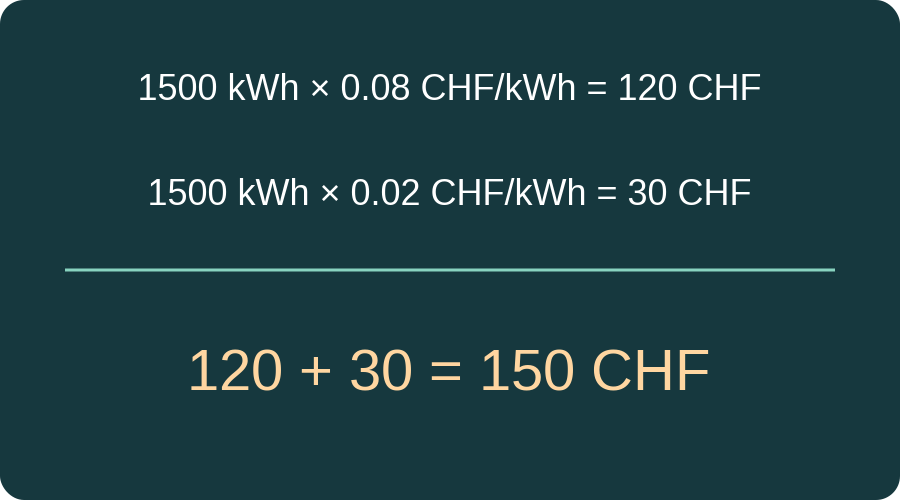
Take a fictional quantity of 1500 kWh and an assumed energy price of eight centimes per kilowatt-hour. In francs this is 0.08 CHF, producing an energy amount of 120 CHF. Suppose a separate agreement in this example also pays two centimes for ecological value on the same eligible 1500 kWh. That additional component is 30 CHF. Together they total 150 CHF before any taxes or charges. The assumptions are selected to explain arithmetic, rather than describe a distributor's actual offer.
If the received statement instead uses 1320 kWh on its energy line with the same fictional price, it produces 105.60 CHF. The difference from 120 CHF is 14.40 CHF, corresponding to 180 kWh. This identifies the scale of the question but does not prove an error. Investigate differing dates, revised measurements, estimated readings or another documented explanation. A useful enquiry presents both the quantities and the calculation, allowing the issuer to address the precise discrepancy instead of responding to a vague complaint about a low payment.
Examine guarantees of origin separately
Pronovo describes guarantees of origin as certificates separated from the physical electricity flow. Their transfer and payment should therefore be checked against the relevant agreement. Do not assume an ecological payment is missing merely because it appears on different paperwork from the energy credit. Conversely, a general reference to solar electricity does not explain which certificates were transferred, for which production period, to which purchaser and under what payment conditions.
A standing order can transfer certificates to an electricity trader or supplier under the system's conditions. Check the recipient, covered period and parties' confirmation. A certificate quantity should not automatically be equated with an export-settlement line when the measurement arrangement or agreement differs. Ask how recognised volumes were established. The objective is to follow the documented ecological value, not to claim it twice or assume every certificate receives the same treatment as every exported kilowatt-hour.
Reconcile the gross credit with the bank transfer
Multiplying quantity by price may not immediately reproduce the bank payment. Look for an offset, advance, earlier balance, adjustment or charge provided for in the applicable paperwork. A deduction's appearance proves neither that it is justified nor that it is unlawful. Ask for its exact description, contractual basis and relevant period. Retain the response with the original statement, rather than editing the original amount to make it resemble the transfer and losing the distinction between the two.
Do not infer your VAT treatment from an example concerning another owner. Operator status, agreement and tax circumstances require appropriate review. Our electricity-bill checking method supports purchase-side reconciliation; it does not replace examination of sales proceeds. Keep generation, income, charges and tax questions distinguishable so that an adviser can locate the necessary records. Reconstructing an entire year solely from bank movements is harder because several different accounting components may have been combined into a single transfer.
Find estimates and corrective statements
Look for references to estimated data, substituted values, cancellations and replacement statements. A correction may concern a period that was already paid and appear months afterwards. Connect the new document to the previous version instead of adding both amounts as independent income. Where a line becomes negative, ask whether it reverses an earlier entry, changes the settled quantity or records another explained operation. Preserve the sequence until the issuer identifies which version should govern your reconciliation.
Build a short event log covering meter changes, communication failures, moving house, account-holder changes and technical modifications. These dates help focus the investigation without prejudging its result. Missing information in a consumer application does not always mean that billing data are missing from the operator's system. Ask about the status of the series used for settlement, the dates of revisions and which observations are final. A chronology can reveal a transition problem more efficiently than comparing unrelated annual dashboard screenshots.
Avoid manufacturing discrepancies in your spreadsheet
Place the statement quantity, relevant reading quantity, difference and explanation on the same period row. Check decimal separators, thousands formatting, date order and whether a totals row was imported as an observation. A file exported in a different language can be misinterpreted by spreadsheet software. Work on a copy and manually verify selected rows before trusting the overall sum. Keep formulas and assumptions readable so that someone else can reproduce the calculation without reverse-engineering hidden adjustments.
Do not alter meter, inverter or battery settings to force the figures to agree. A payment question should first be addressed through records and responsible contacts. If the measurement diagram remains unclear, request an explanation from the authorised professional. A useful household review stops before electrical intervention. Its purpose is to locate an unexplained difference, not turn the owner into a metering technician, require access to protected equipment or risk changing the very measurement arrangement being investigated.
Send a precise, answerable enquiry
Provide the case identifier, statement number, period and disputed line. Attach the received document and relevant readings, then show your calculation with units. A constructive formulation is that the statement quantity differs from the supplied readings over the specified boundaries, followed by a request to explain the data and corrections used. This gives the issuer an answerable question and allows for a legitimate explanation before either party treats the difference as an established billing error.
Ask whether the reply is information only, a correction in preparation or a newly issued statement. Keep the contact reference and a follow-up date. Check complaint deadlines and review routes in the relevant documents and with the competent organisation; there is no universal deadline assumed here. If a material disagreement remains, have a qualified person examine the complete file. Repeated incomplete messages to different services are less effective than a coherent chronology accompanied by the agreement, readings, calculations and previous replies.
Keep an archive you can use again
Create a folder for each year and installation containing the contract, tariff appendices, original data, statements, corrections and payment evidence. Use filenames showing period and version. Add a short note recording measurement conventions and any unusual arrangements explained by the operator. If the house is sold or inherited, this archive helps the next responsible person understand the settlement without depending on a former owner's private login or a contractor's inaccessible mailbox.
When the reconciliation is finished, distinguish established findings from unresolved questions. You may verify the multiplication while still awaiting an explanation of the quantity or certificate transfer. Do not turn that completed check into a prediction of future investment returns. The practical benefit is narrower and dependable: understanding which electricity was paid for, which reference governed the price and how the payment connects to available records. That provides a reusable foundation for checking the next settlement with much less effort.
A checklist before filing the credit
- Identify the account holder, property and measurement point concerned.
- Align agreement, reading and statement periods precisely.
- Distinguish inverter generation, self-consumption and measured exports.
- Verify the unit, conversion, applicable price and rounding convention.
- Reconstruct energy, guarantees of origin and offsets separately.
- Identify estimates, corrections, meter replacements and cancelled documents.
- Submit a focused enquiry with references, supporting records and explicit arithmetic.
- Archive the reply, corrected version and bank reconciliation without double counting.
An understandable credit should connect to identifiable quantities and conditions. If a link is missing, request the corresponding evidence before drawing a conclusion. You can then accept the payment with confidence or seek a substantiated correction, while retaining a file that remains useful for subsequent quarters, a new administrator or a future owner of the installation.