
Integrated Solar for New Roof (In-Roof / Tiles)
Is your old mechanical tile crumbling and taking on water? Should we replace tiles then put panels on top, or use the 'Coup-Double' solution?
Integrated average overhead
+ 15 à 30%
Aesthetic advantage
Very easy authorization
Pronovo grant
Bonus for 'integrated' (RU-I)
Yield loss
~ -10% (Overheating)
When the photovoltaic panel itself becomes your roof.
Remember the essentials of this issue at a glance before moving on to the detailed analysis and recommendation.
Objective
Decide quickly
Horizon
2026
Approach
Practical decision
Verifications
5
Problem Analysis
On a roof reaching the end of its natural life (often after 40 or 50 years), replacing a thin roof of tiles at 120 CHF/m² to immediately superimpose 250 CHF/m² of photovoltaic panels is no longer the most optimized method. The great development of BIPV (building-integrated solar power) is disrupting this model.
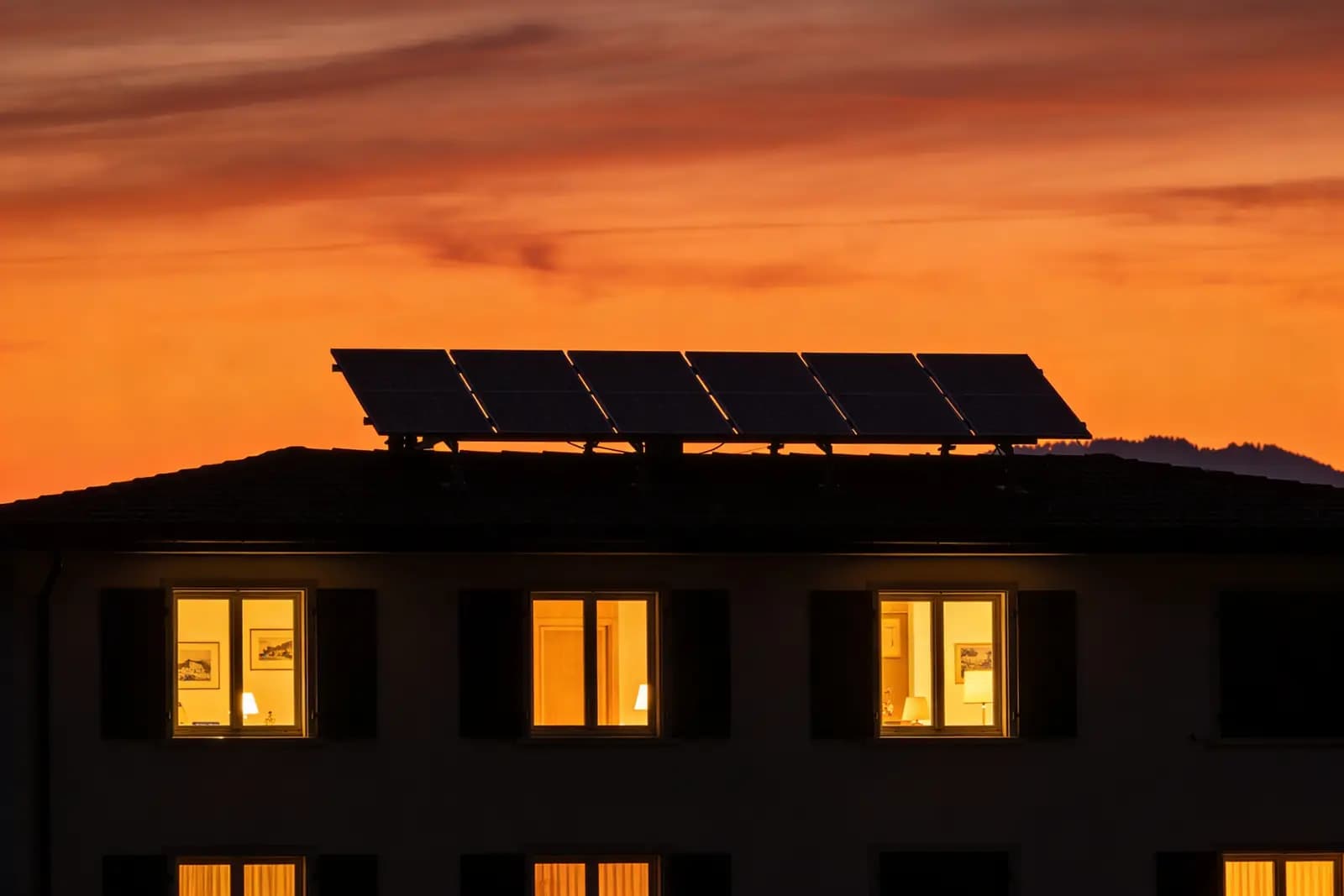
The Integrated Solar Roof (either large interlocking 'In-Roof' panels, or 'Solar Tiles' such as Meyer Burger or Sunstyle) acts as a waterproofing cover AND means of production. It provides a sublime design without excess thickness.
Our Recommendation
Opt for the full In-Roof or the precision Solar Tiles for the New.
These systems certainly cost more for the overall material purchase (quotes often exceed CHF 50 000 to redo a complete roof on a large house in Vaud or Fribourg), but you save all the classic tinsmithing and inert tiles. In addition, the Confederation grants Unique Payments specific to the BIPV (often better subsidized because considered integrated into the framework).
Be careful, however: natural air flow is strongly restricted under this type of integrated roof. In a heatwave, these cells heat up more and, as a result, summer energy efficiency drops by around 10 to 15% compared to a very ventilated 'on-lay' panel.
Sources & Method
Analysis based on ElCom 2024–2026 data, OFEN (Federal Office of Energy), Pronovo SA, EPFL and HEG Geneva studies. The financial projections use the following assumptions unless otherwise stated: local purchase price, GRD injection price, production 1 100 kWh/kWp/year, self-consumption rate 35–40%. Actual results vary depending on canton, roof orientation and consumption profile. The site may also present its own services or calls for contact related to these subjects.
Next step
Compare several quotes, validate profitability with our tools and then check the contractual conditions adapted to your canton.
No obligation · Transparent data