
Organise the solar-home handover: operator registration, electricity contracts, readings, warranty documents and digital account permissions.

Treat the solar handover as a set of separate transfers
Before buying a house with rooftop solar, establish who owns the equipment, who is registered as its operator, who receives the electricity payments and who controls its digital accounts. Ask for a handover schedule covering those roles, the relevant contracts and the supporting documents. Receiving the front-door keys and seeing a working generation graph do not establish that every relationship has been updated. A clear division of tasks helps buyer and seller finish the transfer without leaving essential correspondence with the wrong person.
Pronovo's explanation of operator status after a house sale states that a property transfer does not automatically change the registered plant operator. That distinction is the starting point for this guide. The steps below are a practical organising method, not a determination of ownership rights in an individual sale. Ask the notary, relevant organisation or contractual counterparty to clarify the documents applicable to your property.
Build a transfer table before the completion appointment. For every relationship, identify its current holder, intended future holder, notification method, required evidence, effective date and confirmation still outstanding. Mark an unresolved field as pending rather than assuming somebody else has dealt with it. A single person can hold several roles, but that does not turn their separate notifications into one automatic process.
Establish what the purchase actually includes
Obtain the equipment inventory and compare it with the purchase documents. Ask whether the modules, inverter, battery, charging point and energy controller belong to the seller or are covered by leasing, contracting, roof-use or another arrangement. Record the location and references of included components from supplied documents. A roof covered in modules can look straightforward while the rights and service relationships behind it require careful explanation.
Our guide to solar and property resale value helps frame the wider purchase decision. For the handover, move from an estimated value to an exact inventory: what will be transferred, which liabilities or recurring services remain, and which contracts must be reviewed? Ask the seller to identify any equipment shown during viewing that is excluded from the transaction. Refer contractual uncertainty to the professional handling the sale.
If the seller remains involved after completion, document the arrangement explicitly. For example, access to a roof for equipment owned by another party is a different question from access to a monitoring application. Clarify who can authorise maintenance, receive notices and approve replacement work. Do not solve these questions by simply giving every participant administrator access to the same account.
Give the operator registration its own action line
Pronovo lists a change-of-operator or beneficiary form among its official forms and documents. Use the current document from that source when it applies to your installation, rather than an unverified copy left in an old email. Ask Pronovo which references and signatures are required for the situation, including any pending support application or other registered arrangement. Keep the submitted version and its acknowledgment together.
Put the plant reference, current operator, proposed operator and requested effective date into your transfer table. Distinguish a notification that has been prepared from one that has been sent, accepted or returned for correction. If a representative is acting, identify the authority under which they can submit the request. A seller's statement that the form is with the agent is useful information, but it is not the final confirmation of a completed registration change.
Where the property transfer and operational responsibility do not coincide, explain the proposed arrangement to the parties advising on the sale. Do not alter somebody else's registered details without the appropriate process. A disagreement about ownership, a death, several heirs or a company restructuring may require additional documentation. Record the unresolved issue accurately and obtain a case-specific answer instead of applying a routine checklist mechanically.
Separate electricity supply, export payments and certificates
Ask the distribution network operator and the relevant counterparties which accounts and contracts concern the property. These can include electricity purchased by the household, payment for exported production and agreements concerning guarantees of origin. Make a separate row for each relationship. Confirm who should provide the meter reference, closing reading and date. Do not assume that notifying one organisation changes every arrangement associated with the photovoltaic system.
Request the actual dated contracts and recent statements. Check the billing address, payment destination, charging periods, applicable tariff and any recurring service charge. Treat the seller's historic income as evidence of past operation under those conditions. It is not a promise of the buyer's future receipts. Household usage, contractual conditions and equipment operation can all differ after a move. Ask the counterparty to explain which terms apply after the proposed transfer.
Our guide to a solar home sold within a few years addresses the broader planning horizon. At handover, your immediate objective is narrower: identify the person responsible for every notice and obtain confirmations that can be matched to the right account. Avoid leaving a payment instruction unresolved simply because the physical installation remains unchanged.
Use meter readings that have a defined boundary
Plan the readings with the organisation that needs them. Record the meter identifier, register, unit, timestamp and whether the value represents import, export or generation. Retain the original file or photograph made through the normal permitted access. An inverter's cumulative production total and a network meter's export register can both be correct while describing different flows. They should not be substituted for one another in a closing statement.
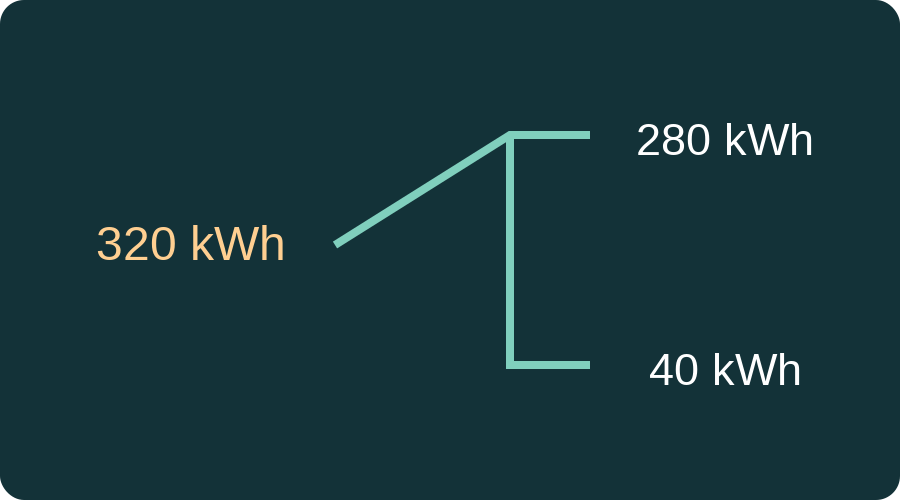
Consider an illustrative period with no battery and aligned measurement boundaries. Generation rises from 67000 kWh to 67320 kWh, giving 320 kWh. The export register rises from 34560 kWh to 34840 kWh, giving 280 kWh. The difference is 40 kWh used directly within the stated boundary. This arithmetic explains the readings; it does not establish a reimbursement amount, which depends on the relevant contract and agreed period.
If storage, shared consumption, a meter replacement or missing intervals complicate the boundary, ask the responsible operator to explain how the figures should be interpreted. Preserve a meter-change report rather than joining two unrelated counters as though they were continuous. If a reading cannot be obtained on the agreed date, record the gap and ask for the accepted procedure. Do not invent a plausible number to make the transfer table look complete.
Transfer application permissions through the supported process
Create the buyer's own account and complete any registration steps before the digital handover appointment. As one manufacturer example, the Fronius Solar.web support documentation distinguishes owner, supervisor and guest roles, and describes changing the system owner from the existing owner's settings. Follow the procedure for the actual platform installed at the property. A visible dashboard alone does not establish the permissions assigned to the buyer.
Agree what the buyer should be able to do through the normal owner interface, then verify those functions without changing technical settings. Check that the correct property appears, historic records remain available as expected and relevant notifications reach the intended address. If the current owner cannot complete the process, use the manufacturer's support channel and its requested evidence. Do not delete the existing system or reset equipment merely to force it into a new account.
List ongoing access for the installer, service company and any other authorised participant. Decide which permissions should continue and obtain confirmation of the changes made. A temporary shared password is a poor substitute for individual accounts with appropriate roles. Our guide to inverter data, access and cybersecurity helps prepare these questions while keeping the technical configuration under the responsible professional's control.
Match warranties and maintenance promises to written documents
Collect the original installation invoice, product references, commissioning evidence, warranty registrations and service agreements. Ask the issuing company which benefits are transferable, which notification is needed and what documentation the buyer must retain. Avoid describing every remaining period on a brochure as a transferable promise. A manufacturer warranty, workmanship obligation and paid maintenance plan can have different counterparties and conditions.
Record outstanding defects, support tickets and previously proposed corrective work. Include who reported the issue, its reference, the response received and the next action agreed. A closed invoice does not necessarily mean that an open service ticket has been resolved. Conversely, an old warning that was professionally addressed should be accompanied by the relevant closure evidence rather than left as an unexplained screenshot in the folder.
Use our guide to the solar safety-record dossier to identify missing inspection documents. Ask the relevant professional which record covers the current configuration. Keep electrical safety, roof condition and contractual coverage as separate subjects in the purchase discussion. A buyer should know which professional answer is still required, without being asked to inspect electrical equipment personally.
Check subscriptions, communications and privacy deliberately
List paid monitoring features, connectivity services, mobile data subscriptions and maintenance appointments associated with the system. Ask who is billed, whether a service will continue after completion and what the buyer must do to retain it. Changing the household internet subscription can affect communications without changing ownership of the generating equipment. Arrange any required network configuration through the supported owner or installer procedure, with a clear fallback contact.
Historic household consumption can reveal private routines. Agree which operational records are appropriate to hand over and obtain the platform's explanation of how access and retained history work. Do not forward the seller's entire personal mailbox or identity archive to make a technical dossier complete. Share relevant installation documents through an agreed channel, and keep any necessary identity verification within the provider's official process.
Identify the destination for equipment alerts and routine notices. The seller should not remain the only recipient of messages about the buyer's property. At the same time, remove a professional's access only after checking whether it is needed for an ongoing service arrangement. Record the resulting roles and notifications so that a later change of phone or email address does not recreate the same confusion.
Prepare a completion-day packet with clear exceptions
Put the equipment inventory, contact sheet, readings, document index and transfer table together before the appointment. Add the acknowledgments already obtained, with the relevant reference beside each one. Keep keys, physical access arrangements and digital roles distinguishable. A paper folder handed across a desk is valuable only if the buyer can tell which processes are finished and which still depend on an external organisation.
For every pending item, name the responsible person, next action and follow-up date. Examples include a form awaiting a signature, an operator acknowledgment not yet received, a warranty question sent to a manufacturer or a missing measurement attachment requested from an inspection company. Describe the actual status. The word done should be reserved for an outcome supported by the relevant confirmation, rather than for a request someone intends to send later.
Where the sale professional needs an unresolved matter reflected in the transaction documents, provide the underlying correspondence and seek their guidance. Do not invent a retention amount, legal deadline or contractual remedy from a general guide. A checklist organises evidence and responsibilities; it cannot decide a disputed obligation between buyer, seller and a third party.
Walk through a realistic incomplete handover
Imagine a buyer receives the property keys, a roof plan and a guest invitation to the monitoring portal. The seller has notified the household electricity supplier but has not identified the registered plant operator. The installation appears to work normally. The transfer table should still show open actions for operator registration, export-payment arrangements, account permissions and any missing technical documents. Operational appearance does not close those administrative questions.
The buyer first asks for the plant reference and current contracts, then arranges the required notifications with the relevant parties. The existing portal owner carries out the supported digital transfer when possible. The buyer checks access and the installer confirms ongoing service permissions. Readings are recorded using the references requested by the network operator. Each confirmation is attached to its own row, preventing one completed step from concealing the remaining gaps.
This scenario is fictional and is not an account of a customer installation. It illustrates sequencing: identify the relationship, request the correct action, retain the result and verify that it belongs to the property. The method also explains why a smooth handover may require preparation before the completion date, even when no new solar equipment is being installed.
Review the first bills and messages after the move
After the transfer, compare the first correspondence with your table. Check names, property reference, billing period, payment destination and the account concerned. An invoice can arrive later while referring to an earlier period. Keep its stated dates rather than assigning it solely according to the day it reached your inbox. If something differs from the confirmed arrangement, send a precise enquiry with the relevant acknowledgment and readings.
Check whether monitoring updates, alerts and planned service communications reach the buyer through the intended channels. A communication gap should be investigated through the normal support route, without assuming that the entire handover failed or that generation has stopped. Preserve the agreed equipment configuration and avoid adjusting electrical settings while resolving an account issue. Ask for clarification when actual responsibilities differ from the contact sheet.
Finally, keep a concise closing note listing completed transfers and any remaining exception. The next person dealing with the installation should be able to identify the operator, contract holders, service contacts and owner account without reconstructing the sale from scattered messages. This makes the handover useful beyond completion day and gives the new homeowner a clear starting point for ordinary operation, future maintenance or an eventual resale.