
Find a missing record, reconcile its scope and signatures, and prepare a precise professional request for your solar installation documents.

Start with the missing document, rather than a second inspection booking
Ask for the signed safety record, its associated test documentation and the precise installation covered by them. If one of these is missing, identify whether it was never issued, was issued but not handed over, concerns only part of the equipment, or describes an earlier configuration. Those situations require different follow-up. A sunny-day production graph cannot establish which inspection was performed, and an invoice marked paid does not identify the person who accepted the electrical work.
This guide is a homeowner's method for organising the evidence and requesting the right professional response. It does not teach electrical testing or certify a system remotely. Keep the equipment in its documented operating condition while you clarify the paperwork. If the responsible professional reports a defect or gives an operating restriction, follow that installation-specific instruction. Questions about a missing attachment should not become a reason to improvise measurements, open an enclosure or alter protective settings.
The ESTI explanation of low-voltage installations describes the safety record and the owner's responsibility to present it when required. Start your enquiry with the property's address, the relevant installation and the date of the work. That makes it much easier for an installer, inspection company or distribution network operator to locate the appropriate file.
Separate the documents before comparing their contents
Create separate folders for the commercial contract, technical documentation, electrical checks, network connection and subsequent maintenance. A quotation explains what was ordered. A commissioning sheet records a stage in bringing equipment into service. A safety record concerns the stated electrical installation. A monitoring login gives access to operational information. These items can support one another, but their purposes differ. Keeping them apart prevents a warranty brochure from being mistaken for an inspection result.
Within the electrical folder, retain the complete record and every referenced attachment. Request readable originals rather than cropped photographs from a messaging conversation. Check whether a page says that a measurement protocol or defect list forms part of the document. A filename ending in final does not prove that the version was signed or that the appended observations were resolved. Preserve the covering message because it may identify the issuer and explain the scope.
For the commercial side, our roof and installation warranty guide helps you prepare separate questions about workmanship, materials and coverage. Avoid combining them into a single request asking whether everything is guaranteed. An electrical inspector, roof contractor and equipment manufacturer may each hold a different piece of the evidence you need.
Identify the installation without disturbing it
Write down the site address, building reference, owner named in the documents and location of the inverter. Add equipment references from existing invoices, manuals or photographs already supplied at handover. Include a battery, charging point or additional generator if it belongs to the project you are investigating. Describe these as an inventory to be confirmed, rather than deciding yourself which circuits fall within a particular inspection.
A useful scope note distinguishes the photovoltaic array, inverter, connection to the building, storage and later modifications. For example, an original roof installation may have received a replacement inverter and then a battery extension. Three dates in the folder can therefore describe three legitimate stages. Ask which record covers each stage and how the current configuration is represented. The aim is a traceable relationship between equipment, work and documentation.
Do not climb onto a roof, remove a cover or disconnect a connector to obtain a serial number. Explain that an identifier is inaccessible through the normal owner interface and ask the appointed professional to confirm it from their records or during an appropriately planned visit. A document checklist should reduce uncertainty without creating a separate access or electrical hazard.
Read the administrative fields and signatures together
The ESTI FAQ on safety records identifies information including the installation address, description, inspection period, installer and inspection results. Use those headings as questions for the issuer. Check whether the owner and building are correctly identified and whether the description is specific enough to distinguish the solar installation from unrelated work elsewhere on the property.
Read the signature area alongside the company details and authorisation references. A company logo alone does not tell you who carried out a check or in what capacity they signed. If a name is unclear, request a legible copy and an explanation of the person's role. If the firm has changed its name, retain the historical document and ask how the old and current company references relate. Do not edit a signed record yourself to make it look current.
The same FAQ explains that limited installation authorisation and general installation authorisation involve different documentation responsibilities. Ask the issuing professional to state which authorisation and inspection arrangement apply to your installation. Do not conclude that every differently titled protocol is invalid, or that every contractor can issue the same document. A clear explanation should connect the applicable role with the evidence actually supplied.
Compare ratings with a simple worked example
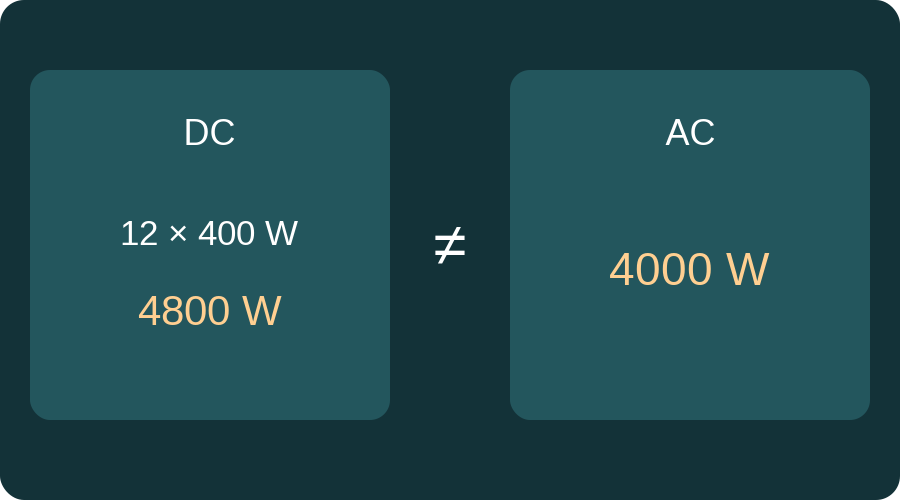
Imagine that the equipment schedule lists 12 modules rated at 400 W each. The arithmetic gives 12 × 400 W = 4800 W of nominal module capacity under the stated rating conditions. The inverter documentation might separately list 4000 W of alternating-current output. Those entries describe different components and do not, by themselves, prove a mistake. Ask for the design explanation if a document appears to compare them as though they were identical quantities.
Now suppose a later invoice mentions 2 replacement modules. Ask whether they replaced existing units or increased the array. A replacement can leave the module count unchanged, while an extension changes the equipment inventory. Record the actual references and the professional's explanation instead of adding invoice quantities together. This small reconciliation often reveals why two documents contain different totals without implying that either document has been falsified.
This example is illustrative, not a reference design or an acceptable electrical configuration for your roof. It requires no owner measurements. Its purpose is to show how a straightforward numerical check can produce a precise question: which equipment and which stage of work does this figure represent? Keep the answer with the corresponding drawing or specification rather than leaving it in an isolated telephone note.
Classify the gap before asking somebody to repair it
A lost copy can often be addressed by locating the issuer's archive. An unsigned draft needs a response from the person responsible for issuing the completed document. An unresolved observation needs confirmation of the remedial work and the evidence required to close it. A record for another address needs a correction from its issuer. An old record preceding an extension needs an explanation of the additional scope. Describe the observed gap without prematurely choosing the remedy.
Prepare a short table with columns for document, installation, date, issuer, missing item and requested response. Enter unknown when information is unavailable. This is more useful than a folder labelled non-compliant, which assumes a professional conclusion you may not be equipped to make. It also prevents several recipients from each assuming that another company will supply the missing attachment.
If you discover both a paperwork gap and an equipment problem, record them separately. State the observed message or behaviour accurately and follow the established support procedure. Our after-sales and monitoring guide explains how to prepare that service request. A missing certificate should not obscure an actual warning, while an unrelated app problem should not be presented as proof that an inspection failed.
Recover the file through a clear contact sequence
Start with the firm that delivered the relevant work and identify the order or invoice reference. Ask for the signed record, associated protocol and any subsequent closure document. If an independent company attended, contact that organisation for its own report using the appointment date and property details. Ask the network operator which evidence it has received and which matter remains open. Each recipient should be asked about records within its responsibility.
Where an owner has changed, seek the original handover pack through the seller, property administrator or representative authorised to act. Request documents about the installation rather than access to someone else's personal mailbox. If a company no longer operates, record unsuccessful contact attempts and ask the network operator or an appropriately authorised professional how the missing evidence should be addressed. Do not assume that paying another business automatically reconstructs a historical inspection.
Use a written request that can be tracked. Include the property, equipment concerned, relevant work date and a list of the exact missing pages. Attach only what the recipient needs to identify the case. Ask who will respond and when you should follow up. A concise, well-labelled message is easier to route than a large archive of unrelated quotations, family correspondence and bank documents.
Verify the professional role before commissioning additional work
ESTI maintains public authorisation registers. Use the relevant register and the full legal identity supplied by the professional when checking their stated authorisation. An advertising badge or membership logo is a different kind of information. If the search result or the scope is unclear, ask the firm and ESTI to clarify it rather than inferring permission from a similar trading name.
For an independent check, ask who will perform it, which organisation issues the result and what independence requirements apply to the work concerned. Request the exact deliverables in the offer. Depending on the situation, the task may involve reviewing existing documents, inspecting the installation, addressing defects or completing a required acceptance process. These are distinct services, and the company should explain the appropriate sequence for your case.
Ask the network operator to confirm any deadline it has communicated and the evidence needed to satisfy it. Keep its original letter. Avoid applying an inspection interval found in a neighbour's file to your own building. The applicable use, installation and record matter. Where different documents appear inconsistent, send both to the responsible professional and request a written reconciliation.
Compare a recovery quotation by scope and evidence
A useful quotation states the investigation, site access, equipment covered, expected report, attachments and treatment of additional findings. Ask whether archive retrieval and document review are included, how an inaccessible area affects the visit, and who coordinates with the installer or network operator. Separate the quoted review from any remedial electrical work that might be identified later. Request the approval process for extra work before accepting the assignment.
Clarify travel, access arrangements, tenant coordination and cancellation conditions. These practical details can explain differences between offers without establishing that one business is more thorough. Ask when the signed documents will be delivered and how corrections to administrative errors will be handled. Keep the final invoice associated with the work it describes, but remember that payment evidence and technical evidence serve different purposes.
If a component replacement is also proposed, use our inverter replacement guide to separate diagnosis, compatibility and the replacement offer. Ask how the resulting configuration will be documented. Replacing equipment merely to obtain a newer-looking folder is not a substitute for identifying the actual defect or documentation requirement.
Make the folder usable for the next owner or service visit
Keep an index showing the latest configuration and the historical documents supporting it. Give each file a clear name containing its purpose, issue date and revision where available. Store the original signed document unchanged; put your explanations in a separate note. Retain both the earlier and corrected version when the issuer sends a replacement, together with the message explaining the correction. This preserves a useful audit trail.
Add a contact sheet listing the installer, inspection organisation, network operator and person who manages the owner's archive. Avoid storing account passwords in the same shared folder. For a future sale, our solar-home handover guide explains the separate transfer of contracts, registrations and digital permissions. A complete technical folder is one part of that handover, not the whole transfer.
Before closing the enquiry, confirm that the requested pages are readable, refer to the right installation, identify the responsible parties and answer the issue you raised. Record any remaining action with an owner and a follow-up date. You now have a practical outcome: either a recovered, coherent set of evidence or a precisely defined professional task, rather than another unexplained certificate in an already crowded inbox.
Prepare an archive that remains readable
Check the files on a second device before relying on your archive. Scanned pages can be blurred, rotated, cropped or protected by a password that only the sender knows. Request a usable replacement from the issuer rather than recreating signatures or copying a stamp onto another sheet. Keep the original attachment alongside any convenience copy prepared for reading. If an online download expires, obtain and store the document while access is available, with the sender's covering message.
Where personal information must be shared selectively, prepare a clearly identified redacted copy and retain the unmodified original privately. Ask recipients which references they need before sending identity documents, financing details or unrelated correspondence. A future technician should be able to distinguish the issued record, its attachments and your working notes without searching through an entire household archive. Add a backup location and the name of the person who can recover it if the usual computer becomes unavailable.