
Reconcile the 100 quarter-hours of 25 October 2026 with your bill using UTC offsets, meter channels and worked kWh examples.
Two readings labelled 02:15 in the meter file
Keep both occurrences of 02:15 on 25 October 2026 until you know what the timestamps mean. A quarter-hourly electricity file for a complete Swiss local day can legitimately contain 100 intervals when clocks go back. A normal day contains 96. A spring day when clocks go forward contains 92. Those figures apply to one continuous channel at a constant fifteen-minute resolution, grouped by the local day it measures. A file grouped by UTC, a cumulative index, a combined import-and-export table, or a record labelled with the end of an interval needs different handling.
Imagine opening a spreadsheet after breakfast to compare October generation with the electricity statement. You sort the time column, see two entries marked 02:15, and reach for the remove-duplicates command. Pause there. Deleting a genuine observation removes energy from the calculation. Leaving a true duplicate in place adds energy that never passed through the meter. The difference can be resolved without touching the meter cabinet, adjusting the inverter clock or changing a single original reading. Work on a copy and collect the definitions supplied with the export.
Establish which clock and which boundary apply
Switzerland uses Central European Time in winter, one hour ahead of Coordinated Universal Time. Summer time is two hours ahead of UTC. The Federal Institute of Metrology, METAS, describes the seasonal arrangement, from the last Sunday in March to the last Sunday in October. On Sunday 25 October 2026 the local clock returned from 03:00 summer time to 02:00 winter time. The wall clock displayed the same hour twice, while elapsed physical time continued in one direction. The previous spring transition occurred on Sunday 29 March. These dates are useful test cases for a download covering the full 2026 calendar year.
The autumn local day began at 22:00 UTC on the preceding Saturday and ended at 23:00 UTC on Sunday. Subtract those boundaries and the duration is twenty-five hours. The same UTC calendar date, measured from midnight to midnight in UTC, still lasts twenty-four hours. An export with ninety-six observations for that UTC date is therefore plausible. Convert timestamps to the property's time zone before labelling the calendar day. Do not add a constant winter offset to an entire year containing a summer season.
Before opening the file in your usual spreadsheet application, save its original bytes. Name the working copy with the delivery point, period and download date. Replace any personal identifier with a private nickname if someone else will review the example. Store the explanatory notes together with the data. Some portals expose a setting for local time, UTC or a standard offset. Capture that setting too. A screenshot can document a selected option, although it cannot establish what an ambiguous file actually contains. The operator's specification or a written explanation settles that question better.
Read the column headings like a contract
Choose one measurement channel. Grid import and export are different directions. Inverter generation is measured at another boundary. A battery controller may show charge, discharge, state of charge and a calculated house load. Two rows with identical timestamps can simply belong to different channels. Separate by delivery point, device, direction, unit and measurement type before checking duplicates. In an apartment building, distinguish the common-services meter from a tenant's meter. In a house with a dedicated heat-pump meter, a second series can represent real consumption behind separate wiring.
Decide whether the numerical value is interval energy in kWh, average power in kW or a cumulative register reading. Add energy values across adjacent non-overlapping intervals. Multiply average power by the interval duration in hours to obtain energy. For consecutive cumulative readings from the same unchanged register, take the later index less the earlier one. A maximum power observed during an interval is unsuitable for an energy calculation without additional information. Read the unit from the documentation even when a filename contains the word consumption. A convenient guess can leave an unnoticed factor of four in every comparison.
A German-language portal may distinguish Bezug and Rücklieferung. A French interface might label the same directions soutirage and injection. An Italian bill may display prelievo and immissione. Preserve the operator's original channel descriptions in your audit notes. The ewz energy-data factsheet illustrates the distinction between power and energy and describes specific services offering quarter-hour values. It also distinguishes provisional deliveries from subsequently checked information. Service conditions depend on the operator and product. A household download elsewhere in Switzerland may have a different time convention, file format or validation timetable.
Two lines that look alike
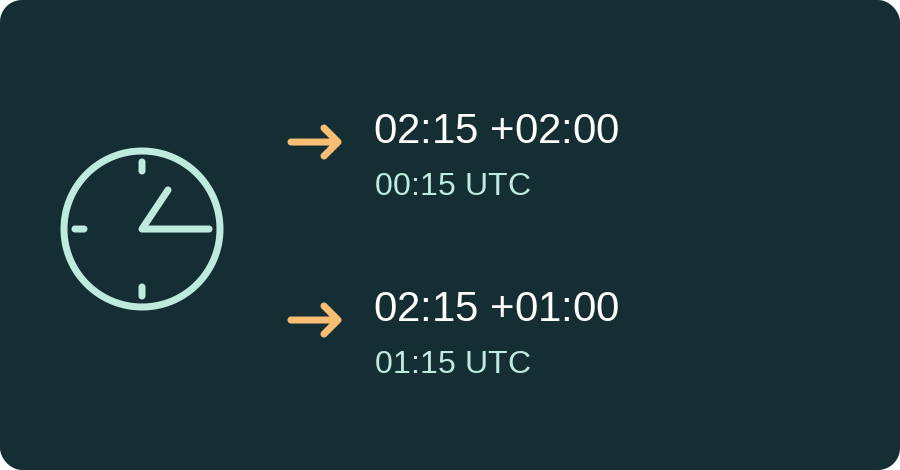
Here is a deliberately small invented example. An interval starting at 02:15 with offset +02:00 begins at 00:15 UTC. An interval starting at 02:15 with offset +01:00 begins at 01:15 UTC. Their wall-clock labels match. Their starting instants are one hour apart. If the energy values are 0.11 and 0.23 kWh, both belong in the local day's total. Together they contribute 0.34 kWh. Identical energy values in those two rows would not make either row disposable. A freezer can draw about the same energy in two legitimate intervals.
For the full repeated hour, suppose the first four quarter-hours contain 0.10, 0.12, 0.08 and 0.14 kWh. Their sum is 0.44 kWh. The second four contain 0.18, 0.16, 0.12 and 0.14 kWh, for a total of 0.60 kWh. Together both physical hours account for 1.04 kWh. A deduplication rule that keeps the first occurrence of every local label silently removes 0.60 kWh. A rule that keeps the last removes 0.44 kWh. Neither choice can be defended by looking at the printed clock label alone.
Make a small comparison drawing on paper. Draw two parallel rows with four boxes each. Above the first write summer offset and above the second write winter offset. Put the four numbers in each row, then carry each sum into the daily column separately. This simple visual shows why a plotted curve with one dot per printed hour can hide legitimate energy. For a meeting with a co-owner it is easier to follow than a screenshot of a pivot table grouped automatically by hour of day.
Start labels, end labels and missing rows
A period described as 00:00 to 00:15 may be labelled 00:00 by one supplier and 00:15 by another. An end-labelled midnight observation can belong to the final quarter-hour of the preceding local day. Establish the convention before throwing away the first or last row of an export. Treat each interval conceptually as including its start and excluding its end. If the file labels the end, reconstruct the start by subtracting fifteen minutes of elapsed time from the identified instant. Then assign the interval to its proper local date.
Check continuity after converting unambiguous instants to UTC. Sort each channel by instant and compare neighbours. Fifteen minutes between successive starts is expected for a complete quarter-hourly series. A thirty-minute gap warrants investigation. It is not proof of zero consumption. A blank may mean an unavailable reading, a delayed transfer or a missing portion of the export. A measured zero is a different observation. Keep a status column distinguishing measured, estimated, corrected and absent values wherever the supplier provides those flags.
If offsets are absent, preserve the original file order. Inspect any sequence number, interval identifier, timezone setting or explanatory header. Request a UTC export or explicit interpretation from the operator if ambiguity remains. Never infer the offset from a plausible-looking kettle spike, the sunrise time or the day the file was downloaded. Appliance schedules and daylight vary, and arrival order can change during a later correction. Mark ambiguous intervals as unresolved and explain the uncertainty before comparing costs or accusing a supplier of billing the same electricity twice.
Import the file without damaging it
Use the import dialogue and inspect the preview. Choose the actual delimiter, decimal separator and encoding. A semicolon-separated file with decimal commas can break when imported with comma-separated defaults. Keep timestamps as text in the first pass so the software cannot silently discard offsets, change month and day order or interpret midnight in the computer's local zone. A laptop travelling abroad may be configured differently from the Swiss property. Preserve leading zeros on identifiers and avoid rounding small kWh entries to whole units.
Create working columns for original timestamp, explicit offset, normalised instant, local service date, channel, unit, amount and validation status. Keep a simple row number pointing back to the source line. Format the energy column with enough precision to preserve what the supplier reported. Perform rounding only after aggregation and use the precision required for the comparison. Multiple legitimate values near 0.05 kWh can disappear from an aggressively rounded chart even though their daily sum is material. When comparing two versions of the same export, retain both download dates.
Filter away other meters and directions before counting. For 25 October, a clean local series should have twenty-five hours multiplied by four intervals per hour. Inspect the neighbouring Saturday and Monday as controls. If every day has exactly one hundred rows, the explanation probably lies elsewhere. Perhaps the download includes opening and closing indices, a summary line, or duplicate pages from combining exports. Inspect several raw lines at the boundary between files. Overlapping downloads often contain the same final day twice. Remove overlaps only after matching channel, actual instant, unit, status and revision.
Bring the solar inverter into the comparison
To compare a rooftop system with the billing meter, line up equivalent intervals first. The inverter reports electricity generated. The boundary meter reports electricity moving between the property and the grid. A house can generate 2 kWh during a sunny interval, consume part on site and export the rest. The grid meter will not independently exhibit the full 2 kWh as an export. In autumn both occurrences of the repeated hour happen at night in Switzerland, so a large photovoltaic generation spike there deserves a check of timestamps, units, battery discharge and device labels before interpreting performance.
A battery introduces another boundary. Its dashboard may report discharge as supply to the building while the solar-generation series stays at zero. Inverter and battery conversion losses also affect a detailed energy balance. Begin by reconciling imports from the same meter with its own billing statement. Only then compare generation and storage series to investigate behaviour inside the premises. In a tenancy handover, record any device or meter replacement. Putting the previous occupant's final index beside the new meter's first index can produce an apparent reset that has nothing to do with the clock change.
An example illustrates unit conversion. A quarter-hour interval at an average 1.6 kW contributes 1.6 multiplied by 0.25, or 0.40 kWh. Four such consecutive intervals deliver 1.60 kWh over one physical hour. Adding four raw power values gives a number with the wrong meaning for comparison with an energy bill. If the portal has already converted each row to kWh, multiplying again understates usage fourfold. Write the formula and units above the spreadsheet rather than relying on a coloured column or a remembered setting.
Reconcile the bill and communicate a discrepancy
Read the billed period, meter identifier, reading status and direction. Compare the settled kWh with the same local period from the matching channel. Identify estimates, corrections or changes of meter before investigating price. Keep fixed charges and taxes out of an energy reconciliation. When energy matches but money differs, investigate tariff periods and rounding independently. A dual-rate customer may need to assign intervals to the network operator's applicable time bands. A repeated local label alone does not establish which rate the contract applies to either occurrence.
Prepare a short support enquiry if the discrepancy persists. Include the date, meter nickname or secure account reference, relevant channel, time basis, unit, number of observations, exact difference and two or three representative rows. Explain the treatment of midnight and the repeated hour. Ask whether the values are provisional and which timestamp convention the operator uses. Send account data through its normal customer channel. An unredacted annual load profile can reveal vacations, regular absences or overnight activity. It rarely belongs on a public discussion board.
Finally, keep a reusable test. An ordinary complete local day has 96 quarter-hours, the autumn transition has 100 and the spring transition has 92. Record one verified example of each alongside the documentation for your actual meter. On the next download first check the service point, direction and units, then compare the timestamps, then reconcile the totals. If your provider revises the export format, repeat the test before reusing a spreadsheet. A short written trail can save a whole evening of adjusting formulas whenever the clocks change.