
The Swiss renewable minimum rises in stages. Find your standard product and check the share documented by guarantees of origin each quarter.
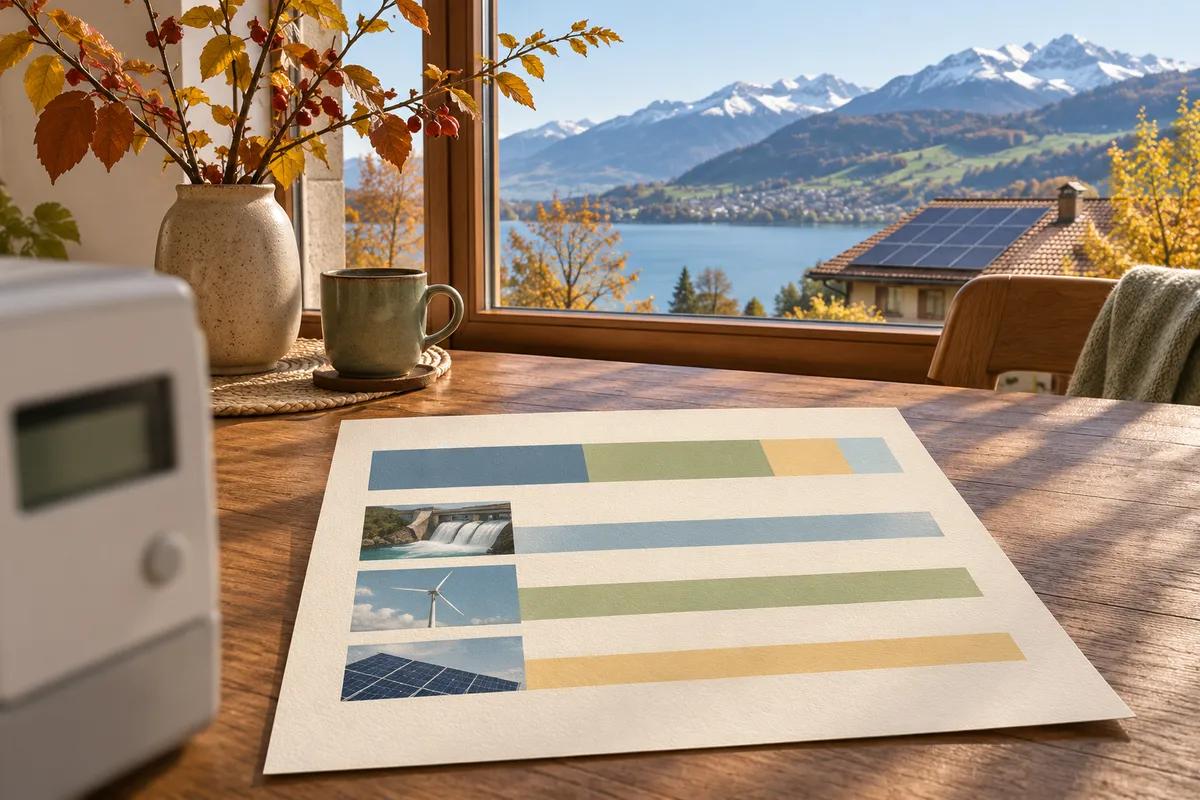
If your distribution operator assigns you its standard electricity product, a specific part of the product’s disclosure will become easier to check. For each quarter, what share of the delivered electricity is backed by evidence of Swiss renewable production? A revision adopted on 25 November 2026 stages the increase in that minimum share. Its general effective date and the first tariff year covered by the new minimum are separate. That distinction matters when you compare a recent bill, a supplier announcement and an electricity disclosure covering a period that has already ended.
Start with the paperwork that identifies your product. Take out the latest tariff notice, find the product name in your customer account and look for the source disclosure for the same period. If you operate rooftop panels, keep the contract for selling your exported power in a separate folder. All of these documents may mention renewable Swiss electricity while describing different transactions. This guide shows how to establish the scope of the disclosure, calculate a worked example and ask your distribution operator a question it can answer with a specific document.
Identify the product assigned to your meter
Basic supply is the framework under which the distribution operator provides electricity to the consumers concerned. Within that framework, the standard product is assigned by default. A separate optional product can have its own name, branding and composition. Its appearance in a catalogue tells you that it is offered. You still need to check the actual assignment for your metering point. In a rented property or a building with several meters, a bill may refer to the shared areas, a flat or a different account entirely.
Record the delivery address, the effective period and the full product name for the meter. In a general tariff notice, locate the entry identifying the default offer and the entries listing alternatives that customers can order. If a property manager issues the statement, ask which product it uses for the relevant meter. Once the product and metering point are clear, you can ask for the right disclosure and reject comparisons between figures that refer to different parts of the building.
Read the calendar of the adopted revision
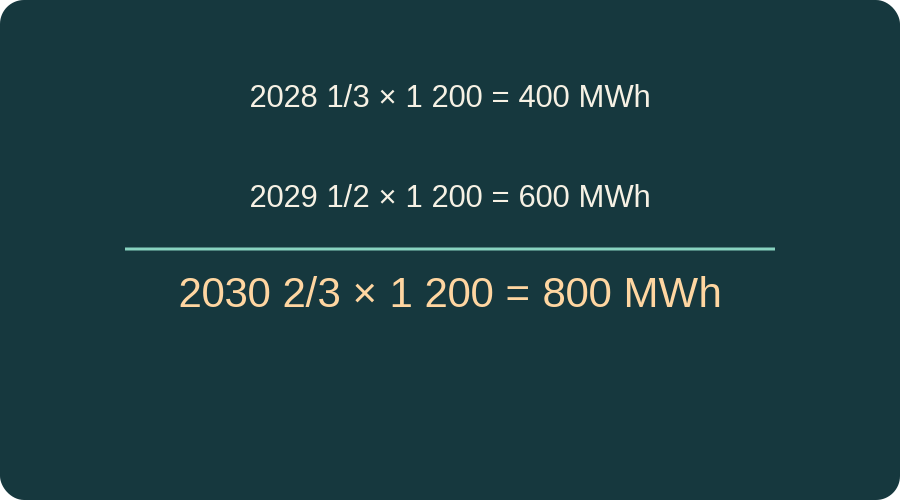
The Federal Council announcement places this change among the energy revisions approved on 25 November 2026. The general effective date is 1 January 2027. In the provisional ordinance amendment, Article 4b sets a minimum of one third for tariff year 2028, one half for 2029 and two thirds from 2030. The final publication in Fedlex provides the authoritative wording.
Keep two questions separate when you read a supplier’s statement. One concerns when the revision takes effect. The other concerns which minimum applies to the particular product and tariff year you are checking. Keep the issue date and original location of every notice you rely on. Information received near the end of the calendar year may already describe a future product. Asking explicitly for the tariff year is a quick way to resolve the apparent mismatch with a disclosure for deliveries already completed.
Compare quarters within the same tariff year
The unit of comparison is delivery over a quarter. The denominator is the amount supplied under the standard product during that quarter. The numerator counts the share supported by guarantees of origin documenting both Swiss origin and renewable generation. A published annual mix is useful as a broad summary. Additional information is needed to reconstruct the evidence for quarters with different volumes and different purchasing patterns.
Create a column for each quarter. Put the tariff year and product at the top, then list the documented share and where you found it. If the operator provides only an annual result, ask how it is derived from the underlying delivery records and source evidence. Two percentages can differ because their periods differ. Capturing dates in your comparison avoids treating a difference in reporting scope as a defect or attributing a seasonal change in volumes to a change in the product.
Work through the minimum with simple volumes
Consider a hypothetical supplier delivering 1200 MWh under the standard product in one quarter of tariff year 2028. One third of that volume is 400 MWh. If the relevant guarantees cover 450 MWh of renewable electricity generated in Switzerland, the resulting share is 37.5 percent, above the minimum in this example. The figures illustrate how the delivery amount and the supported amount combine to produce a percentage you can interpret.
With the same hypothetical delivery volume, the later minimums correspond to 600 MWh in 2029 and 800 MWh in 2030. Actual delivery volumes can change substantially from one quarter to the next. Recalculate each minimum using the relevant volume. Check the unit as well. Your household bill might be stated in kWh while a supplier’s portfolio disclosure is given in MWh. Household consumption and the volume supplied across a whole product serve different purposes and belong on separate rows.
Understand what a guarantee of origin records
A guarantee of origin supplies evidence for electricity disclosure. The Swiss Federal Office of Energy guidance explains the context in which these records are used to inform consumers. Categories for generation technology, country and period help describe the attributed electricity. Physical flows follow the instantaneous conditions of the interconnected electricity system. The records establish a documentary allocation for the purposes of disclosure.
Use the disclosure to understand the reported supply composition for your product. For a question about the power your home drew on a cold evening or the amount purchased during a particular hour, look instead at meter readings and contract information. Those two types of evidence answer complementary questions. A revised annual disclosure can clarify the description of the product, while a time series remains the appropriate source for reconciling a question about your building’s own consumption.
Distinguish renewable, domestic and photovoltaic generation
The minimum combines two characteristics. An amount with Swiss origin can be associated with a category that is outside renewable generation. Renewable output generated abroad does not meet the domestic requirement. A single headline figure for certified volume therefore needs a breakdown if your question concerns the category that is both Swiss and renewable. Two separate percentage figures also tell you very little about their intersection unless you know precisely what each includes.
Photovoltaic generation can contribute to the qualifying share, along with other eligible renewable technologies. If you want to identify specifically how much is attributed to solar generation, look for a breakdown by technology and confirm that the figures correspond to the standard product. Owners who already produce solar power can use that information to understand the character of their purchased electricity. The overall renewable share cannot answer the question about photovoltaics on its own.
Keep electricity disclosure separate from quote prices
The energy charge on a bill can move with purchasing costs, changes to a tariff structure and the scope of supply. The staged minimum describes documented composition. To calculate the francs potentially avoided when you consume a kilowatt-hour of solar generation directly, identify the applicable tariff and the variable items that decrease as grid purchases fall. A useful quote states the assumption, issue date and period clearly enough for you to compare it with the bill.
Put the price components and origin information into separate columns. On the price side, record the amount, unit and type of charge. On the other side, record the electricity product, tariff year and published share. If the coming year’s price is unavailable, prepare cost scenarios with explicit assumptions. An increase in the supported share gives no specific rate of price increase or decrease. A clear separation makes it easier to update the financial model when published rates arrive.
Read the export agreement in its own scope
When your roof produces surplus energy, the export agreement identifies the buyer and the conditions for payment. Note the settlement period, exported volume and the treatment of any associated guarantees. On the statement, check whether the guarantee is paid through a separate line, dealt with under another agreement or included in a published combined amount. The same term can appear on a household supply disclosure and in a sale agreement, with its role described differently in each.
If the same distribution company supplies your home and buys your surplus, ask separate questions about purchases and exports. Specify the meter and period for each. Keep the signed agreement, measured volumes and the applicable tariff notice with the settlement. That filing arrangement remains useful if the owner changes, if the installation is extended or if you select a different supply option. It also lets you compare what the contract says with what the export statement actually records.
Ask the operator a question it can verify
A suitable request is: “Which standard product is assigned to my meter, which tariff year does it apply to, and where can I see the breakdown of its Swiss renewable share?” Add the title of the document you have and the dates shown on it. If you want to reconcile a specific delivery quarter, name it and ask for the relevant record or for an explanation of how the amount was calculated.
An actionable reply should allow you to locate the document and reconcile its titles with the contract. If the answer directs you to the operator’s company-wide mix, ask whether that mix also describes the standard product for the tariff year at issue. Record the date and version of the reply. When circumstances change, you can return to the same criteria and see whether a different share reflects a different product, reporting convention or period.
Compare commercial claims on an equal basis
One brochure may show the renewable portion of an optional premium product. A second report may describe the mix supplied to all of the operator’s customers. The two documents can use the same branding while covering different populations, tariffs and products. Add a row for each and give it fields for the customers covered, product name and reporting period. If the heading is vague, use any product identifier on the document to frame a written enquiry. A footnote may delimit a comparison to residential accounts, exclude individually negotiated contracts or use a categorisation particular to a subsidiary. Make those qualifications explicit in the worksheet so a later reader can reconstruct the correspondence between the promotional material and the applicable disclosures.
Distinguish the promotional detail from the linked source disclosure. A brochure might highlight a named power station and link to a publication aggregating several sources of purchased energy. A useful source for your comparison identifies the relevant product, period and composition. If you cannot establish those details, save the brochure for background and request the appropriate statement. This preserves the marketing claim while allowing you to verify how it relates to your own supply.
Trace the paperwork in a shared building
In a building with jointly maintained areas and multiple households, two residents can see different statements even though the street address is the same. Identify the flat meter, the communal electricity and any arrangement for billing locally used solar power. The property manager may be able to confirm the contract and product for common loads without sharing any neighbour’s private consumption records. A request that names the relevant meter helps the manager locate the right information.
If a product or operator changes during the reporting period, add start and end dates to your record. Associate each statement with its respective meter. For a budget comparison, preserve the tariffs applying on both sides of the transition. That record is useful when owners later review the minutes of a meeting or ask a new property manager to explain why the published origin figures look different from the previous report.
Save the evidence for the next tariff year
Download a version that identifies the product and reporting period in its heading. Preserve both the statement and its publication address. In your own note, separate the verified entry, the interpretation and anything still open. A joint owner, relative or future operator can then find the evidence without retracing an entire investigation or relying on an unlabelled screenshot.
The practical check leads to three decisions. Confirm the product assigned to you, verify the scope of the reported share and keep solar budget amounts in their own records. If quarterly information is hard to locate, save your request and the supplier’s answer together. When new disclosure is published, those records help you identify what changed across comparable periods and distinguish it from a new product name or a change of price.
Keep corrections and new versions traceable
An origin table can be republished following a correction to wording, a change of format or a data revision. If you find two statements for the same tariff year, compare their dates and look for any notice that one has replaced the other. Check whether a category has been renamed, combined or broken down before inferring a change in purchased supply. A short note about the edition can explain a discrepancy between two screenshots from the customer portal.
For a multi-year comparison, preserve the original categories and the definitions behind totals. Save an explanatory note if the operator sets out its rounding conventions or presentation choices. A spreadsheet can mark a value as missing without assigning it a zero. That distinction separates an unverified entry from a reported absence of volume. It becomes especially valuable when someone else inherits the worksheet or needs to make sense of the figures at a later meeting. Version history also makes it possible to reproduce an earlier comparison after an archived attachment disappears from a redesigned portal. Record any date expressly described as an upload timestamp, and preserve the provenance of a table copied into a separate document.
Apply the distinction to a renovation decision
A heat pump, redesigned controls and additional solar modules can each change a building’s demand profile. The stated origin of purchased power remains an attribute of the product. The amount still needed from the grid depends on design, operating habits and actual output. When comparing options with a technical adviser, ask for those quantities in separate fields. Clarify which of them can be checked against existing records before you make a commitment.
For a smaller project, a short worksheet can be sufficient. List the current supplier, product, published origin, observed consumption and associated costs. Next to them, state the assumptions about future uses and the checks that follow installation. Owners can then consider the contract alongside the project budget and expected operation. The origin disclosure enhances a decision already grounded in a realistic forecast rather than carrying the weight of the investment case by itself. For example, a household might be able to document an appliance replacement from its installer’s schedule and quantify changed consumption after commissioning. Meanwhile, the origins of any residual purchases can be followed through a periodic statement from the supplier. That arrangement gives each person assessing the renovation a clear evidentiary trail.