
The 23 November announcement concerns electrical efficiency. Separate project applications, existing programmes and photovoltaic support before committing.

Understand the 23 November announcement before changing your plans
The Swiss Federal Office of Energy announcement published on 23 November 2026 concerns electricity savings. It describes the ProKilowatt 2027 call, with project applications already open since 2 November. A business considering more efficient equipment can investigate that route. A household planning rooftop panels should first distinguish electricity generation from reduced consumption. A similar origin for public funding does not mean that the application channel, eligible participants or conditions are interchangeable between these two kinds of investment.
According to the official announcement, the nationwide project budget is up to CHF 40 million. That allocation is neither an individual award nor a discount you can already deduct from a solar quotation. Start by describing what will physically change at your property. Will you generate more electricity, replace an electricity-intensive machine, or pursue both objectives? Your answer identifies the organisations to contact and the evidence needed for an informed decision.
Separate panels from the equipment using electricity
Draw two columns on your preparation sheet. Put modules, inverter and expected generation in the first. Use the second for ventilation, pumps, lighting or other equipment whose electricity requirements you intend to reduce. Leave a third area for shared tasks: electrical design, contractor coordination, timing and metering. This prevents a broad sales label such as energy transition from turning different expenditure into an apparently unified application that somebody assumes will automatically qualify for support.
For the photovoltaic component, begin with our Pronovo guide and the conditions relevant to your installation. For efficiency, consult the SFOE overview of ProKilowatt. Ask the responsible organisation to confirm the route actually available for your measure. A battery shifts energy through time; its presence alone does not establish an eligible electricity saving. Similarly, increased self-consumption does not prove that a machine requires fewer kilowatt-hours to deliver the same useful service.
Find the appropriate route for a household
A private homeowner should not infer direct eligibility for the project call merely from having a Swiss address. The institutional overview distinguishes projects implemented, for example, by businesses or municipalities from programmes that reach participants through a separate programme operator. It also states that existing programmes continue, despite there being no new programme call for 2027. Investigate the particular opportunities available for your equipment and your actual ownership and occupancy arrangements.
Before sending invoices, record the existing model, proposed replacement, municipality, equipment owner and desired timing. Ask which existing programme is still accepting applications and under what conditions. An individual offer may have its own scope, process and remaining resources. None of this creates a universal reason to buy immediately. For a shared building, establish who authorises expenditure and who submits the application: a resident, managing agent, owners’ association and service provider do not perform identical roles.
Define a business or municipality’s decision
For a small business, start with the service required: moving air, pumping liquid, refrigerating a store or lighting a workshop. Record operating hours, quality requirements and periods without occupants. A replacement can look efficient in a catalogue while unnecessary operation during closures still consumes electricity. Collect observations that the operator can explain rather than reconstructing an annual figure solely to support an attractive commercial claim about savings or funding.
Document the legal entity, site address, responsible person, equipment and ownership arrangements. Where buildings or tenants share an installation, establish its exact boundary before combining results. A school, professional kitchen and mechanical workshop do not necessarily have equivalent operating patterns or restrictions. Our business solar guide places this decision within wider energy planning. It does not replace the technology-specific requirements of a funding route or a discussion with the organisation administering it.
Check the timetable and a discrepancy between documents
The documents checked on 25 November do not all state precisely the same final submission date. The general overview and announcement mention 1 November 2027; the timetable in the detailed 2027 conditions states 31 October 2027 for the last project applications. Do not simply choose the later date because it is more convenient. Obtain confirmation from the ProKilowatt office and allow enough time to correct missing or unclear attachments before submission.
Language versions also need care. A later sentence in the French announcement contradicts its own opening description of continuing project applications. The official German announcement clearly distinguishes projects from the suspension of a new programme call. The detailed conditions state that their German version prevails in case of doubt. Keep the office’s response alongside the document version used for your decision. A bookmarked link alone will not explain the original uncertainty when someone reviews the file later.
Build a baseline that another person can verify
Photograph only labels accessible without removing protective covers and collect available technical sheets. Record electrical input, control method, operating hours and changes in activity. A building bill may combine heating, computing, catering, vehicle charging and solar generation. It provides economic context, but does not necessarily attribute a saving to an individual machine. Label measured information, manufacturer figures and operating assumptions separately instead of presenting them as evidence of identical quality.
Create a short reference log containing the observation week, person responsible, units, unusual events and calculation method. An exceptional closure, fault or tenant change can distort the comparison. Retain original files and identify the metering location. Someone else should be able to follow your reasoning several months after the assessment. That record is more useful than a standalone dashboard screenshot with no legend, identifiable period or explanation of the consumers included in its displayed total.
Try a savings example without inventing a grant
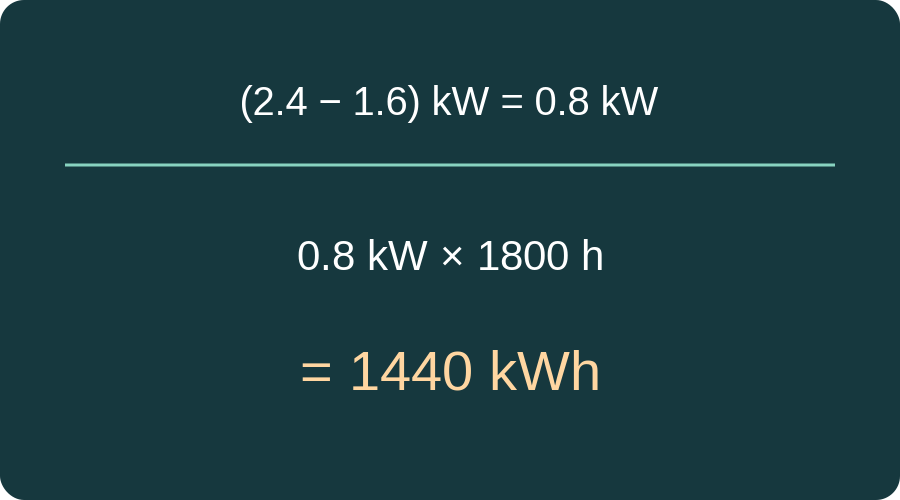
Consider a hypothetical ventilation system drawing an average of 2.4 kW for 1800 hours annually. A suitably assessed alternative would require 1.6 kW to provide the same service over that period. The illustrative difference is 0.8 kW; multiplied by 1800 hours, it gives 1440 kWh per year. This explains units and scope. It is not a diagnosis of your building, the complete official application methodology, or confirmation that this particular replacement would qualify for support.
Before using the figure, establish whether the power values come from operating measurements, modelled averages or simply equipment nameplates. Check air quality, flow rates, noise, maintenance and seasonal settings. Reducing the useful service to display a lower consumption is not a comparison of equivalent solutions. If business activity increases, show that as a separate scenario instead of hiding the change. The accepted calculation method and technical conditions must then be confirmed for the real technology and measure.
Reassess self-consumption after demand falls
At a property already generating solar electricity, saving energy may alter exchanges with the grid. Removing a midday load may leave more surplus, while removing a night-time load is more likely to reduce purchases. Do not automatically value every avoided kilowatt-hour at the same price. Use the relevant hours and contracts for the address, separating the import price, export remuneration and fixed charges that remain unchanged by your proposed improvement.
To illustrate the mechanism only, suppose that 100 kWh previously consumed directly would instead be exported. At assumed prices of CHF 0.28 for imports and CHF 0.08 for exports, the difference for those 100 kWh is CHF 20. This does not make efficiency pointless: the complete balance includes other hours, activities and costs. The solar calculator helps explore scenarios. Request a building-specific assessment when generation, ventilation and storage interact rather than treating one simplified calculation as the final investment result.
Organise a combined renovation into clear work packages
Number the packages when solar panels and consuming equipment are assessed together. Distinguish rooftop generation, fan replacement, control changes and performance monitoring, for example. Allocate drawings, quotations and responsibilities to each package. Explain shared costs: a coordination visit should not silently appear at its full price in several comparisons. This structure improves the budget even if no contribution is ultimately requested or awarded for any component of the work.
Identify who checks interactions too. A changed extraction system may affect comfort and the operation of a room; solar-led control may move a machine’s operating hours without improving its efficiency. Keep the useful service central to the comparison. If an adviser proposes combining measures in an application, have that arrangement checked against the applicable conditions. A commercial decision to bundle equipment does not replace an assessment by the scheme or identification of the actual applicant and beneficiary.
Prepare evidence before making binding commitments
The implementing organisation’s information says that the funding decision must be awaited before ordering material or signing contracts connected with implementing the measure concerned. Tell the office the true status of each proposal: quotation received, option reserved, order signed or works started. Do not assume an agreement with a vendor automatically preserves eligibility for an operation that has already been committed or begun under a different interpretation of the process.
Collect the technical description, baseline, alternative, costs and proposed evidence method. Identify internal approvals and the person authorised to confirm the application. Businesses sometimes lack a document simply because finance staff and the equipment operator use different names for the same installation. Homeowners can meanwhile prepare solar drawings and investigate other suitable support. Keep the decisions distinct so that an unresolved efficiency enquiry is not mistaken for a universal approval covering all work at the property.
Compare quotations against the service actually retained
An advertised electricity saving should accompany a usable operating result. Ask about availability, maintenance access, spare parts and staff training. At occupied premises, plan interruption windows, protection of rooms and return to service. A cheaper purchase can create more coordination work; a sophisticated alternative can introduce subscriptions or computing dependencies absent from the initial proposal. These differences deserve attention before a possible contribution focuses the discussion on one apparently attractive net amount.
Build two budgets: construction expenditure and future operation. Separate assessment, supplies, installation, adaptations, checks, monitoring and recurring charges. Deduct a possible contribution only within an explicitly labelled assumption, and show the scenario without it. Your comparison should remain understandable if the amount sought changes or the application is rejected. This is a way to structure an investment decision, not a forecast of an administrative outcome or a guarantee about the financial performance of equipment.
Plan the evidence needed after implementation
Decide during the assessment who will collect invoices, product references and final measurements. In a shared building, define access to readings and responsibility for explaining changed operating patterns. Replacing equipment alongside different opening hours requires careful interpretation: not every bill variation comes from the new hardware. Retain the selected settings, acceptance date and differences between the original proposal and the actual work so that future readers know which option was genuinely implemented.
When results are unexpected, compare equivalent periods and services first. Review recorded events before assuming a new technical fault. Where the application needs a particular form of evidence, have the relevant organisation explain its format and deadline. Careful preparation remains useful beyond funding: a future technical manager can understand the choice, continue monitoring and avoid losing the project’s history when employees or contractors change. A complete handover is more valuable than a folder containing only the successful sales presentation.
Answer the questions that hold owners back
Does the absence of a new programme call mean all household opportunities disappear? The SFOE says existing programmes continue; examine each offer actually available and its rules. Can the national budget be entered as guaranteed support in a panel quotation? No: an allocation and an individual award are separate facts. Does increasing self-consumption establish efficiency? It does not by itself demonstrate a reduction in electricity needed for an equivalent service.
Should every construction project automatically wait until 2027? The announcement describes a procedure already open, not a universal recommendation to delay. The appropriate sequence depends on the component concerned, commitments already made and the responsible office’s response. Prepare your information now, identify uncertainties and obtain written clarification before the purchase concerned. For photovoltaic support, consult the 2027 solar funding guide, keeping its conditions distinct from those of ProKilowatt rather than assuming the programmes fund the same expenditure.
Use a shared preparation checklist
Copy this list for a discussion with your advisers. It is not an official application; it allocates questions among owner, operator, consultant, vendor and administering organisation. Each answer should point to a document or a named responsible person. Unknown information needs a specific next action rather than an improvised estimate, particularly when two projects progress at the same premises with different deadlines, approval chains, evidence and sources of finance.
- Describe solar generation, equipment efficiency and shared works separately.
- Identify the owner, operator, signatory and intended beneficiary for each component.
- Confirm the accessible support route and the version of its conditions.
- Document baseline demand, useful service, hours, units and assumptions.
- Clarify conflicting dates and allow time for application corrections.
- Check which orders and commitments are permitted before the relevant decision.
- Compare investment, maintenance, recurring charges and the scenario without support.
- Allocate acceptance, final evidence, monitoring and archive responsibilities.
The next step is a targeted discussion with the scheme office or an existing programme operator, accompanied by a precise description. This avoids building a solar decision on a headline that also concerns other investments. The announcement offers a possibility to examine carefully, not an identical funding promise for every Swiss roof or every appliance an owner might want to replace.