
The 25 November decision separates January commencement from April photovoltaic rates. Check installation category, commissioning and quotation.

One new decision, two different starting dates
On 25 November 2026, the Federal Council adopted a revision of photovoltaic investment support. The practical change for a homeowner preparing a project concerns the power-related contribution in two capacity bands. However, the general commencement of the energy ordinances in January does not mean that the higher solar contribution starts then. The published photovoltaic annex assigns the new rates to commissioning from the beginning of April 2027. Confusing these dates could leave a budget relying on assistance several months too early.
The official government announcement establishes that the revision was adopted. For the actual dates and rates, read the photovoltaic annex on pages four and five. The attached ordinance still carries a provisional-version notice, identifying the definitive Fedlex publication as authoritative. Keep the reference you consulted and check the applicable final wording before relying on a particular project entitlement. A national announcement is different from approval of an individual application.
What has changed since the earlier discussion
Our earlier guide to installation timing considered a proposal. The fresh development is its status: the government has now announced adoption and published revised supporting documents. This does not instruct every homeowner to suspend construction. It gives an adviser, lender or property committee a more recent basis for updating an existing calculation, while retaining the technical assumptions that made the original project workable.
Ask the contractor to date the revised estimate and identify its source. A quotation prepared several weeks ago may still contain suitable equipment and a realistic design, yet use an older support rate. Have the funding line reviewed separately from modules, access arrangements, installation, connection and warranty terms. Otherwise a different inverter or a reduced service package might be hidden inside what appears to be a straightforward regulatory update. Version control helps you identify the reason for every material price movement.
Establish the correct installation category
The annex distinguishes building-integrated, attached and freestanding installations. In the capacity band below thirty kilowatts, the indicated rate from April is 440 CHF per kilowatt for integrated installations, compared with 400 previously. For attached and freestanding installations, the contribution increases from 360 to 400 CHF per kilowatt. These figures describe the power-related contribution within that band. They are neither an installed equipment price nor a recurring annual electricity saving.
Do not choose a category from panel colour, appearance or closeness to roof tiles. Ask the person preparing the application to explain the classification and the evidence supporting it. A visually discreet rooftop system does not automatically qualify as integrated equipment under the programme. Before accepting a net quotation, connect the category to the construction description, roof design and intended official calculation. Keep unresolved assumptions visible rather than selecting whichever label produces the largest apparent discount.
Treat larger capacities as a separate calculation
For the band from thirty to below one hundred kilowatts, the published contribution changes from 330 to 370 CHF per kilowatt for integrated installations and from 300 to 340 CHF for attached or freestanding installations. The increase is therefore forty francs in this band too. A larger roof still requires the applicable banded calculation; it should not be valued by multiplying its entire capacity by a residential rate copied from a small-system example.
An apartment building or workshop should obtain an explanation of capacity boundaries, operating arrangements and any extensions. Ask which portion is assigned to each band and how existing equipment is handled. Different figures in the quotation may describe module capacity, inverter output and network connection capacity. Those quantities serve different purposes. Preserve the definitions and units used by the relevant application procedure instead of replacing one figure with another simply because it improves the funding estimate.
Keep ordinary and high one-off remuneration distinct
The annex also provides for high one-off remuneration for the relevant new installations without self-consumption and below one hundred and fifty kilowatts. Its rate moves from 450 to 550 CHF per kilowatt for commissioning from April. Operating without self-consumption is a defining condition of that route. Applying this higher figure to a house directly supplying its own appliances would misrepresent the example, even if the rate looks financially attractive.
Have the adviser describe the intended operating model before calculating support. Clarify electricity destinations, measurement requirements and the procedure appropriate to the project. Our Pronovo guide helps organise the administrative questions. Specific bonuses, eligibility conditions and special cases still require confirmation from the responsible organisation. A useful comparison considers both investment and subsequent operation; it does not redesign how the building uses electricity solely to obtain the biggest figure in a promotional table.
Calculate a difference without promising a payment
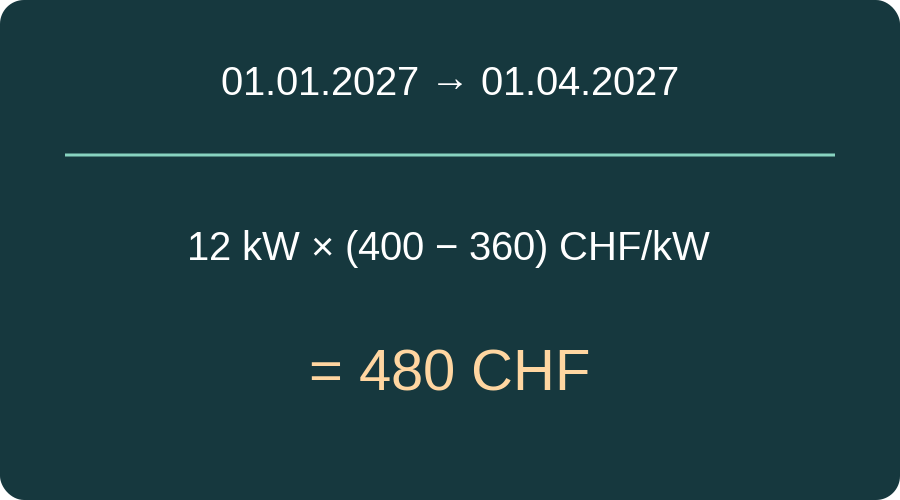
Consider a hypothetical attached installation of twelve kilowatts, entirely within the first band and assumed eligible. Comparing only the power-related contribution gives twelve multiplied by 360, or 4320 CHF before the change, and twelve multiplied by 400, or 4800 CHF afterwards. The difference is 480 CHF. This arithmetic illustrates the published rates. It does not establish that a particular address will receive a payment or that every necessary condition has been met.
Record the exclusions beside your worksheet: other bonuses, local assistance, taxes, financing and project-specific technical adjustments are not included here. Changing the eligible capacity or classification changes the result. Avoid deducting the increase twice from a quotation that already incorporates it. Request separate lines for gross price, assumed support, indicative balance and outstanding confirmations. You can then audit the addition without guessing what a headline “after subsidies” price includes or which uncertainties the salesperson has omitted.
Document commissioning rather than assuming it
The annex organises its tables by commissioning date. Signing a contract, paying a deposit, receiving equipment and fixing panels to a roof should not automatically be treated as that event. Ask which records establish the decisive date in your procedure and who prepares them. Distinguish connection, testing, acceptance and application submission. A credible schedule explains dependencies between these activities instead of treating a single installation appointment as proof that all administrative milestones have been completed.
Where several trades renovate a building, assign responsibilities to roofer, electrician, network coordinator, owner and application representative. An unavailable meter or incomplete submission may affect timing even when the physical installation proceeds as planned. Keep confirmations and acceptance records together. Where the date remains uncertain, ask for a budget under each realistic commissioning window, identifying the event that determines which calculation ultimately applies. Do not solve an unclear schedule by entering a favourable date unsupported by the project documents.
Review a quotation you already hold
First check that the offer still describes your actual project: module quantity, capacity, manufacturer, layout, accessories and necessary site work. Then isolate the support estimate and identify the rate it uses. A quotation may predate the announcement while having its own commercial validity period. The government decision does not demonstrate that a supplier must maintain a particular installation price until the spring, nor that an unsigned offer remains available without changes.
To compare solar quotations, retain a consistent scope. Request a numbered revision, marked changes and explicit exclusions. If an amendment affects equipment or deadlines, examine warranties, access and coordination as well. A revised net price may barely change because an equipment substitution offsets the higher assumed contribution. Transparent versions reveal that distinction. Keep superseded documents for reference, but mark clearly which version you are considering so that an old payment schedule is not accidentally treated as current.
Maintain a separate column for local programmes
The federal decision does not settle every cantonal, municipal or electricity-provider programme. Identify the schemes relevant to the building's address and ask about applications, evidence, deadlines, eligible spending and combination rules. A local programme may require a check before ordering or starting work, independently of the federal commissioning date. An answer given for a neighbouring property does not confirm that your address, installation type or applicant falls within the same conditions.
In a jointly owned building, establish who applies and who receives the payment. An owners' resolution, management mandate and construction contract do not necessarily serve the same purpose. Retain official replies with their dates and scope. If an organisation has not yet confirmed assistance, show that amount as pending rather than a guaranteed reduction. The budget should remain understandable both with and without the additional contribution, especially where different owners bear different costs or benefit from different electricity arrangements.
Separate installation support from operating income
One-off remuneration supports investment. Export revenue pays for electricity delivered later. The announced increase does not guarantee a fixed selling price throughout the lifetime of the panels. Avoided purchases also depend on household timing, applicable tariffs and building characteristics. A single additional contribution therefore cannot establish a universal payback period. It is one input among several and should remain separate from assumptions about annual production, demand, operating expenses and future equipment replacement.
Prepare an installation budget and an operating worksheet. In the latter, distinguish expected production, self-consumption, exports, maintenance, subscriptions and possible replacements. Use the existing calculators to explore scenarios with clearly identified assumptions. Tax treatment requires an assessment suited to the owner; it should not be added as an automatic discount. A cautious estimate can be updated when a tariff or local condition is confirmed, without obscuring which part of the original result has changed.
Resolve unusual cases before placing an order
Extensions, previously ordered equipment, partly operating systems and installations serving several buildings need specific review. Present the actual history to Pronovo or the authorised representative. A fresh application form should not artificially portray an existing project as entirely new. Identify the existing case reference and distinguish retained equipment, additional capacity and replaced components. Ask how these facts affect the procedure before assuming that the simple twelve-kilowatt illustration applies to your circumstances.
For a business, coordinate this review with access to the premises and operational requirements. For a landlord, clarify meters and the recipients of financial flows. Such details may influence the route and supporting records without appearing in a manufacturer's brochure. Seek a written response on the concrete situation, attaching relevant plans and established dates. The aim is to resolve uncertainty before it becomes a discrepancy between an expected contribution and the amount recognised when the application is examined.
Prepare a useful discussion with the professional
Send a short project brief containing address, owner, intended category, capacity, self-consumption arrangement, realistic timetable and quotation version. Include known roof, network or shared-ownership constraints. Ask for an explanation of the calculation rather than just a screenshot of its result. Another person taking over the file should be able to reconstruct the inputs, rate version and remaining conditions without relying on a salesperson's memory or private correspondence unavailable to the owner.
During the discussion, allocate each follow-up: technical evidence, consent, schedule, simulation or local confirmation. Agree a suitable review point before ordering or amending a contract. Archive the exchange with the revised offer. This organisation remains useful if construction moves to another season or the representative changes. A dependable decision uses information that can be handed over, checked and corrected. It is stronger than an informal promise based on several dates mentioned together without identifying which one controls the contribution.
Check the definitive documents before submission
The documents consulted on twenty-six November accompany the government's announcement. The published explanatory report confirms the distinction between January commencement and April photovoltaic rates. The provisional notice on the attached ordinance means that its definitive publication should be checked before using it for a commitment. National information can be accurate while still being insufficient to determine an unusual installation's eligibility, a particular bonus or the handling of an extension.
Keep dated copies of your references and revisit them for the final application calculation. If an adviser cites an earlier consultation document, request the relevant updated version. If a general announcement and a detailed table seem inconsistent, ask which specific provision is being applied and why. You do not need to interpret a complex rule unaided. You need an explanation linking the requested contribution to documented characteristics of the installation, the applicable rate and the evidence establishing its commissioning date.
A checklist before changing your budget
- Distinguish government adoption, general commencement and the photovoltaic rate's starting date.
- Confirm eligible capacity, installation category and operation with or without self-consumption.
- Calculate the increase separately from total support, bonuses and other financing.
- Identify the decisive commissioning event and the documents that establish it.
- Compare quotation versions with equipment, services and exclusions clearly traceable.
- Confirm local assistance and applicable combination conditions independently.
- Separate investment, operation, taxation and assumptions about future export income.
- Recheck definitive publication and archive replies before submitting the application.
The useful action today is to obtain an explained update to your project file. The announced change can improve the estimate for a realistic commissioning window, while technical assessment and project conditions still determine the outcome. A revised quotation and documented schedule provide a stronger basis than a general promise that every installation will automatically benefit from the higher contribution.