
Compare portal access, monitoring, travel, visits and parts using a defined scope, a ten-year scenario and an organised records handover at cancellation.

Compare an annual service rather than a subscription label
Before accepting a solar service agreement, ask what you will actually receive during a year, what triggers an intervention and which items remain separately chargeable. One monthly price may cover access to a platform; another proposal may include a person reviewing alerts, travel or a visit. Write down those differences before choosing. An available resident owner, a distant landlord and a shared-property manager do not necessarily need the same package even when the offers use similar names.
This guide helps you prepare comparable requests and an operating budget. The figures below are educational assumptions, not market tariffs. The SwissEnergy photovoltaic operating guide, published in 2019, provides a useful framework for monitoring and maintenance principles. Keep its publication date in mind. The actual equipment documentation and the provider’s current written commitments remain important for your installation; a general guide cannot replace the scope agreed for a particular property.
Describe the system the service must cover
Gather installed capacity, inverter references, storage, control equipment and access locations. Add the commissioning date, companies involved and documents available. A provider who knows only the number of panels cannot precisely explain monitoring for a battery, charging point or several meters. Mention difficult roof access, an intermittent internet connection and periods when the home is empty. Those circumstances can influence the work required more than a system size prominently displayed on a quotation.
Keep equipment identifiers, invoices and drawings in a file you control. A list held by the original installer may be incomplete after alterations. Compare it with acceptance records and request corrections where needed. For a recently purchased property, read our solar-home handover guide. A maintenance agreement should not become a substitute for a clear transfer of existing responsibilities and accounts, or conceal uncertainty about who is authorised to request changes to the installed equipment.
Distinguish four services commonly bundled together
Separate portal access, data monitoring, preventive maintenance and fault response. A portal lets you view information; monitoring means a person or rule acts on that information; maintenance describes scheduled tasks; fault response addresses an incident. Ask the vendor to place every promised item in one of those columns. The word monitoring alone does not establish who notices a problem or who subsequently contacts you with an explanation and a proposed next step.
Use a practical example: the inverter sends no readings for three days. Who notices? How often is the record reviewed? What message reaches you? Who checks whether the issue concerns internet access, transmission or electricity production? Our offline solar-app guide helps prepare those observations. The continued availability of a dashboard should not be interpreted as a universal production guarantee or evidence that someone has already arranged technical assistance for the equipment behind it.
List every charge and the event that triggers it
Request a written breakdown covering activation, subscription, any mobile connection, visits, travel, hourly work, consumables, roof access and parts. Record whether tax is included and how long the proposal remains valid. An overlooked recurring line can change a multi-year comparison. Conversely, a higher fixed price may be reasonable if it covers a useful, clearly defined service tailored to restrictions at your property rather than an impressive but irrelevant list of features.
For variable amounts, identify the trigger. Is travel payable as soon as a visit is booked, after remote diagnosis, or only if a hardware fault is confirmed? Does a job needing two technicians follow the same rate? Is safety equipment included? These questions define an offer; they do not determine legal obligations or prejudge a negotiation. Put important answers into the proposal you accept rather than retaining only a memory of a reassuring telephone conversation.
Work through a transparent ten-year example
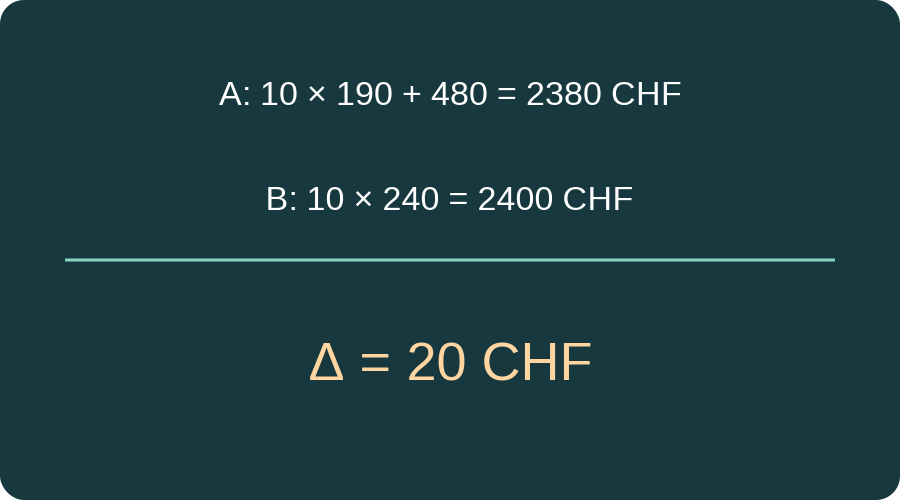
Imagine two fictional offers, initially assumed to cover comparable work. Offer A costs CHF 190 annually and includes an additional hypothetical expense of CHF 480 during the period. Without inflation or discounting, ten years produce CHF 1900 in subscription charges and CHF 2380 in total. Offer B costs CHF 240 annually, without that extra expense under our assumption. Its ten-year total is CHF 2400. The arithmetic difference is only CHF 20. That extra CHF 480 is an assumed service expense rather than a quoted charge.
This does not rank the providers. It shows why an isolated annual price can mislead: under these assumptions, the apparently substantial initial difference becomes almost negligible. Now check whether visits, response arrangements, exclusions and parts are genuinely comparable. The example predicts no certain replacement. If real invoices contain indexation, different taxes or missing services, calculate again. An uncertain future expense should appear as a justified scenario rather than an event treated as inevitable merely to make one package look preferable.
Test price changes and changes in use
Create a second column for items that may change: service price, mobile communication, travel and system modifications. Ask how the agreement handles an added battery, a replacement inverter or a property becoming a second home. A commitment designed for one device may need amendment after another contractor changes the installation. Establish how the inventory will be updated and who checks that the revised record matches the equipment actually fitted at the property.
For a budget test, choose an explicitly illustrative increase instead of claiming a forecast. Compare a year without intervention with a year including a chargeable visit. List costs outside the calculation, such as an exceptional fault, scaffolding or roof renovation. The period selected is not a promise that one supplier will remain available throughout. It helps reveal dependencies and choose a reserve consistent with your circumstances rather than assuming that every unexpected event has already been included in the monthly amount.
Define an alert, a response and an on-site intervention
Receiving a notification does not mean a technician has already been dispatched. Specify monitoring hours, covered days, contact channel, weekend arrangements and information required from the owner. Distinguish acknowledgement, remote diagnosis and attendance on site. Expressions such as rapid assistance or priority service need verifiable definitions. Ask about circumstances that can prevent delivery, including parts availability and a building that nobody can unlock within the proposed appointment window.
Choose examples suited to your use. A home empty for weeks needs an authorised contact with access; a rented property requires coordination with occupants; a workshop may permit work only outside production hours. Allocate communication between these people and retain the case reference plus a timeline of observations. The solar after-sales guide complements this organisation. A service package should not be assumed to cover every warranty, operating or damage risk simply because assistance is mentioned in its description.
Request a useful visit and an understandable report
Ask which tasks the proposed visit includes and what record you receive afterwards. Depending on the agreed scope, checks may concern accessible observations, operating data, apparent condition or points required by equipment instructions. The professional should describe the work. Do not adopt a universal visit frequency from advertising. The environment, hardware, history and applicable requirements should guide a suitable approach, especially where a planted roof or difficult access complicates maintenance arrangements.
The report should identify the date, person attending, equipment examined, findings, limits and proposed follow-up. A general installation checked box explains little to a future owner. Distinguish a defect needing attention, recommended observation and an optional improvement. For electrical work and regulatory documentation, consult ESTI and the appropriate authorised professional. A commercial subscription does not replace required inspections or the competencies needed to perform electrical tasks safely and within the applicable framework.
Clarify cleaning, safety and roof access
Cleaning is not an automatic element of every maintenance agreement. Ask whether it is recommended after observation, scheduled by default or charged according to access. Have the provider explain the method for your actual modules and precautions for materials, water and neighbouring equipment. Our maintenance and cleaning guide helps prepare relevant questions. An owner should not climb onto a roof or open equipment simply to satisfy a request for photographs in a commercial discussion.
Also specify who organises access, informs occupants and protects circulation areas. A visit may require separate coordination with a roofer or property manager. Costs and responsibilities should remain identifiable where a building needs particular protective arrangements. If a safe photograph from ground level does not support a conclusion, state that limitation. Missing accessible evidence is preferable to an improvised inspection that endangers somebody or damages equipment. Treat any necessary specialist observation as a clearly allocated task instead.
Organise account roles and retention of records
List the accounts involved: owner, installer, manufacturer, administrator and any monitoring provider. Identify which are personal or shared and which actions each role permits. Ask about recovery after an email address or telephone number changes. Do not send the main password through ordinary messaging simply to simplify setup. Request an individual invitation or the secure procedure actually supported by the platform, with responsibilities that remain understandable when the original contact is unavailable.
Then examine export options: period covered, detail, file format, possible charges and access after cancellation. These are characteristics to establish, not identical rights guaranteed by every interface. Regularly preserve useful readings, incident records and reports. A graph visible today does not establish that it will remain available years later. An archive organised by date and equipment makes analysis easier when the supplier, homeowner or monitoring application changes and someone needs to reconstruct an event from original information.
Separate warranties, paid services and exclusions
Ask who handles a claim and which documents show the purchase, reference and alleged fault. A product warranty, an output warranty and a maintenance package answer different questions. Discuss labour, transport, diagnosis and roof access explicitly. Do not conclude that a subscription is necessary to preserve every warranty without reading the actual product conditions and obtaining an explanation specific to the equipment sold. A general sales statement is insufficient to settle that question.
Record significant exclusions. Weather events, hardware added by another company, unavailable internet or discontinued parts can be treated differently across proposals. Mentioning an exclusion does not itself determine its legal validity. Where a question is important or disputed, have the agreement reviewed by a suitably qualified person. For choosing a provider today, seek an understandable allocation of tasks and an identified contact rather than a general peace-of-mind promise whose content cannot be compared with another company’s offer.
Prepare for the end of the agreement before signing
Ask about term, renewal, notice period, cancellation method and transfer charges. Put a reminder in your own calendar and retain the document establishing the applicable procedure. A sale, inheritance, management change or provider closing its business can make a handover particularly important. Do not assume a new company will automatically obtain accounts, history and settings from the previous provider without your participation or without checking whether the transfer is technically possible.
Create a handover list covering the updated inventory, available drawings, intervention records, exports, accounts and warranty contacts. Have the provider specify which functions remain usable without the package and which records might become inaccessible. Before switching, ask the incoming company to confirm it can support your equipment. An organised exit reduces missing information and repeated diagnosis. It does not require replacing functional hardware solely because you want a different monitoring or maintenance service.
Send the same clear request to two providers
Describe the installation briefly and attach the records safely available to you. State the objective: delegating monitoring, receiving a documented visit, arranging fault support or simply retaining access to data. Ask each company to distinguish the annual base, options, exclusions and costs triggered by an incident. Targeted questions can make an incomplete offer comparable. Avoid choosing between two prices while the underlying service boundaries remain different or unknown to the person making the decision.
Discuss an ordinary case and a more demanding one. Compare a notification without travel against a replacement requiring roof access and ordered material, for example. Record who authorises additional expenditure and how it is presented before work proceeds. Then choose service appropriate to the tasks you can reliably perform yourself. An attentive resident may retain some observations, while a managing agent may prefer to delegate coordination provided the purchased service is precisely defined and its handover arrangements are clear.
Keep a practical decision checklist
The strongest comparison combines budget with actual service. Use these headings in your discussion, then archive the answers with the signed agreement. Unresolved items need an owner and a deadline. A brochure, monthly price and general review do not replace an agreement about concrete tasks, particularly when a later change of contractor must be organised years after the installation and the original participants no longer remember informal promises or account arrangements.
- Identify every device, reference, owner and available equipment document.
- Separate portal access, personal monitoring, scheduled maintenance and incident response.
- Record fixed fees, options, communication, travel, parts and difficult access.
- Compare explicitly hypothetical financial scenarios over the same period.
- Define alerts, covered hours, contacts, extra-cost approval and reports.
- Check digital roles, account recovery and actual export facilities.
- Distinguish warranties, statutory inspections, exclusions and commercial services.
- Prepare for renewal, cancellation, transfer and a complete records handover.
Your next step is a proposal in which each promise refers to an identifiable service. You can then accept recurring expenditure with a clear understanding of what it funds or request a different arrangement. The objective is understandable supervision, transferable information and an explainable budget, rather than a subscription selected only because its amount looks small on the first page of a quotation or because its description contains an impressive collection of technical terms.