
Coordinate the roofer and solar company: inventory, storage, Pronovo conditions, downtime costs and documented return to service for an existing array.

Plan a temporary interruption as a complete project
If your roof needs renovation beneath an existing solar array, commission a coordinated removal and reinstallation plan before agreeing the roofing date. Identify who takes the installation out of service, inventories the equipment, transports and stores it, restores the roof and returns the system to operation. An offer covering only the act of lifting panels leaves important responsibilities unresolved. The decision is different from renovating a roof before a first solar installation: here, functioning equipment, existing records and possibly continuing support obligations already have to be managed.
Start with the intended result. Do you want the same installation reinstated, an altered layout or a separately evaluated modernisation? Distinguish the necessary roofing repair from optional solar upgrades. A roof contractor should not be left to assume that the solar company will handle every electrical and administrative task, while the solar company assumes the reverse. Name a coordinator and make the interfaces visible in the programme. This owner-focused guide helps organise those decisions; it is not a procedure for disconnecting equipment, handling live circuits or accessing a roof without professional protection.
Establish the existing condition before anything is removed
Collect the original layout, module references, mounting instructions, inverter details, available safety records and previous maintenance history. Ask for a condition survey that distinguishes pre-existing defects from damage that might occur during the works. Record module positions, serial evidence where available, roof penetrations and important interfaces with drainage or weatherproofing. Keep dated photographs and a readable equipment schedule. A pile of visually similar panels without an inventory makes later decisions about reusing, replacing or claiming for an individual item considerably harder.
Do not turn evidence collection into an unsafe owner inspection. Give the appointed professionals the documents already accessible and tell them where information is missing. They can plan the necessary site work, access equipment and electrical precautions. If the roof may contain problematic materials, consult the existing structure and asbestos preparation guide before assuming the solar removal is the only preliminary task. Coordinate investigations early enough that a later finding does not leave dismantled equipment waiting indefinitely while the roofing scope is redesigned.
Allocate the interfaces between the trades
Ask the solar company and roofer to describe their respective handover points in writing. Include scaffolding, lifting, temporary weather protection, roof readiness, retained fixings, cable routes, testing and document delivery. Clarify who checks that a completed roof can receive the mounting system and who accepts the interfaces between supports and the new covering. An owner should be able to identify the person responsible when a question concerns water ingress, a broken module or an electrical operating restriction, without acting as the technical referee between subcontractors.
The Suva solar-roof safety guidance identifies access and fall risks that must be planned for installation and maintenance. Have the contractors explain their site arrangements rather than improvising them after the first appointment is missed. Discuss pedestrian areas, occupied rooms and tenant access as practical constraints. Sharing scaffolding can make sense, but the agreement should still identify each trade's permissions, timing and responsibilities. A common access structure does not merge the professional duties of different companies.
Check Pronovo obligations for a supported installation
For an installation that received a one-off payment, read the conditions of the actual support decision and the current Pronovo questions on temporary shutdown. For roof-repair interruptions, that FAQ describes a reconstruction period of 1 year and requires at least the previous capacity and category to be returned to operation. It also explains that missing the period can lead to proportionate repayment. This is a specific support framework, not a promise that every contractor can safely leave equipment in storage for that length of time.
Notify the intended modification through the applicable process and obtain a written answer for the site's circumstances. Ask how the interruption starts being recorded, which evidence of recommissioning is needed and what happens if the proposed capacity, category or location changes. Pronovo's FAQ also distinguishes relocation and reduced-capacity reinstatement, so do not assume that moving the array elsewhere or reinstalling fewer modules is equivalent to a temporary repair. Keep the correspondence and the original decision together. A funded installation and an installation without that support do not necessarily raise the same administrative questions.
Use the support deadline as a boundary, not a programme
A 1 year reconstruction period should not become the target duration of a roof project. Within the framework described, the minimum operating term is not extended by an interruption completed within that period. Build a realistic sequence with room for weather, investigations, material delivery, specialist availability and necessary checks. Agree an expected removal date, a roof-ready milestone and a recommissioning window. Identify the person who tracks slippage and the moment at which an unresolved issue must be escalated. A verbal assurance that the panels will go back eventually is not a usable programme when equipment, contractors and administrative obligations have to remain coordinated.
Create a contingency route before dismantling. If new roofing materials are delayed, ask where the modules will remain, whether the storage contract continues and how additional visits are priced. If the programme risks approaching the support deadline, contact Pronovo early with the actual facts instead of assuming an extension. Ask the contractors to update the plan after each material change. Distinguish a revised forecast from confirmation that a milestone has been achieved. Keeping those states separate helps prevent a pencilled-in installation appointment from being mistaken for completed return to service.
Verify that the retained equipment suits the renovated roof
Reusing the same modules does not mean that the mounting arrangement can simply be copied. A new covering, added insulation, altered roof geometry or different available fixing positions may change the interfaces. Request a compatibility assessment for the proposed roof and mounting system, including relevant structural, drainage and access questions. The plan should show the intended arrangement after renovation, not only the location of the original array. For roof-integrated modules, clarify which parts provide weather protection during the interruption and in the finished assembly.
Ask which supports and small components can be reused, which must be replaced and how that decision is documented. Do not prescribe frame drilling, improvised clamps or cable extensions to make an old layout fit. If one reference is unavailable, use the separate guide to a discontinued module replacement before accepting an apparently similar substitute. If the proposal instead becomes a broader upgrade, request a separate comparison with straightforward reinstatement. The roofing need should not prevent a transparent decision about the additional scope and remaining service life of the solar equipment.
Agree transport, storage and condition recording
Require an inventory-based handover when equipment leaves the roof and when it arrives at storage. Specify the location, responsible custodian, access arrangements and agreed condition record. Have the professional follow the equipment manufacturer's packaging, handling and storage requirements rather than treating all panels as generic building sheets. Clarify protection from impact, unauthorised access, unsuitable stacking and accidental mixing with materials from another site. The owner should know where the equipment is and how its identity will remain traceable during the interruption.
Ask how a damaged, unidentified or unsuitable item will be isolated from the accepted stock and reported. Record who authorises repair, replacement, further examination or disposal. A temporary removal instruction should not silently become permission to discard usable equipment. Keep the agreed process compatible with any insurance or warranty evidence requirements. If the installer uses an external warehouse or transport subcontractor, clarify the contractual responsibility rather than assuming that outsourcing removes it. A clear record at each transfer helps distinguish a pre-existing defect from a loss discovered only when the array is brought back.
Clarify insurance without assuming uninterrupted cover
Tell the relevant insurer about the planned work and ask which cover applies while equipment is being removed, transported, stored and reinstalled. The answer can depend on the policy, location and contractual arrangements. Ask specifically about theft, handling damage, weather exposure and the interfaces with the building works, without assuming that these risks are automatically included. Identify deductibles, required notifications and evidence needed for a claim. The contractor's own insurance and the owner's policy serve different purposes and should not be treated as interchangeable confirmations.
Keep the response with the project file and share the relevant conditions with the coordinator. If an insurer needs a pre-removal survey or approval before disposal, schedule that step rather than discovering it afterwards. For roof defects and workmanship, use the existing roof warranty guide to separate the questions you put to each party. Do not infer the outcome of a claim from a neighbour's experience in another canton. A written answer tied to your policy and works is more useful than an informal statement that solar equipment is generally insured.
Estimate downtime with the right energy boundary
An interruption can increase grid purchases and remove export revenue, but the figures must refer to the same period and configuration. Start with a realistic counterfactual: what would this installation probably have produced during those particular weeks, and how much would the building have used directly? Use an appropriate site profile and explain its uncertainty. Dividing annual generation evenly across the calendar can misrepresent a spring interruption or a winter repair. State whether the entire array is unavailable or whether a professionally approved part remains operational.
Separate variable energy consequences from costs that continue regardless of production. Fixed subscriptions do not automatically disappear when panels are taken offline. A battery, different occupancy, changed heating use or a new electricity contract may also alter the calculation. Record the assumed purchase price and export payment instead of importing a national average as though it were the site's actual tariff. The purpose is a budget comparison for scheduling choices, not a guaranteed loss claim or a reason to operate equipment contrary to the specialist's safety instructions.
Recalculate an illustrative interruption in francs
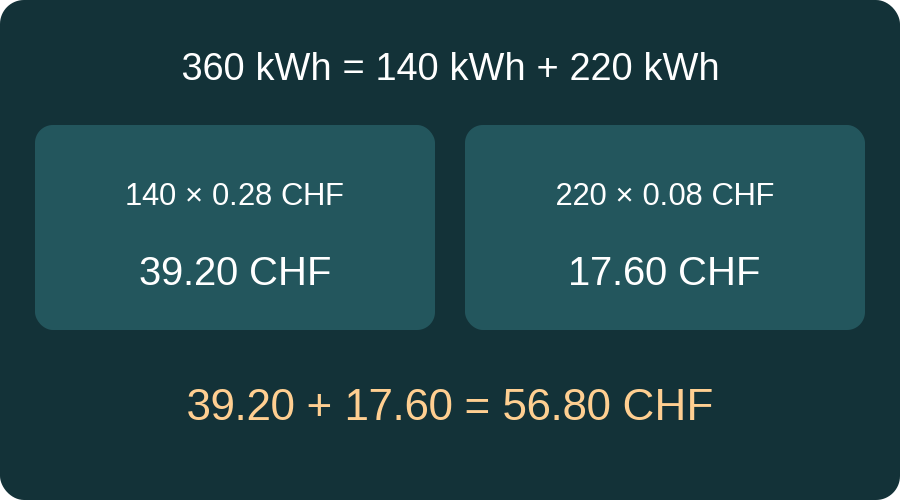
For an illustrative period of 14 days, suppose the unavailable array would have generated 360 kWh. Without storage, assume 140 kWh would have been used in the house and 220 kWh exported. Assume a variable purchase cost of CHF 0.28 per kWh and an export payment of CHF 0.08 per kWh. These are hypothetical inputs, not current offers or tariff promises. Extra purchases are 140 × 0.28 = CHF 39.20. Foregone export receipts are 220 × 0.08 = CHF 17.60. Their combined energy effect is CHF 56.80.
This example deliberately keeps building demand and the rest of the contract unchanged. It excludes scaffolding, labour, equipment, fixed charges, tax effects, guarantees of origin and any support repayment question. Do not add the full value of all 360 kWh as extra purchases and then also add export losses: that would count part of the same energy twice. Replace the assumed profile and prices with the site's documented inputs before making a decision. If the interruption moves to another season, rebuild the energy assumptions rather than changing only the number of days in the spreadsheet.
Compare quotations and define the route for changes
Ask for separate lines covering survey, electrical work, removal, access, lifting, transport, storage, mounting adaptations, reinstallation, required checks and updated documentation. Identify which roofing services are outside the solar company's price. Set out what happens if a module is damaged, a fixing cannot be reused or the roof is not ready on the planned date. A transparent variation process should identify the evidence, price effect and approval route before additional work is undertaken. Avoid an open-ended instruction to do whatever proves necessary without an agreed reporting process.
Use the site's quotation comparison checklist to align assumptions between bidders. Compare the programme and responsibilities as well as the total. A cheaper estimate may exclude storage, another access visit or the final documents; a more expensive offer may include optional upgrades rather than the same reinstatement. Ask for those differences to be made explicit. Where several contractors invoice separately, keep a shared scope register so that a useful interface is not omitted because every party believes someone else priced it.
Define the professional return-to-service handover
Before the work begins, agree which evidence establishes completion. Request the final equipment inventory, revised layout where necessary, relevant electrical checks, installation records, photographs of the finished work and the agreed roofing handover. The ESTI explanation of low-voltage installation documentation helps frame the discussion about technical records. The appointed professionals determine the checks and notifications appropriate to the actual intervention. An appointment confirmation or a delivery receipt for returned panels is not the same as a completed, documented return to operation.
Clarify the handover to the network operator and Pronovo where applicable, and retain their acknowledgements. Confirm that the monitoring account represents the reinstated arrangement and that the coordinator has recorded the actual completion date. Do not erase the original installation history merely because a roof renovation introduced a new event. Where the configuration changed, keep both the earlier and current records with a readable explanation. That makes future service, warranty enquiries and a later property sale easier to manage without relying on the memory of a contractor who may no longer be available.
Observe operation without promising an annual result
Agree a proportionate follow-up that distinguishes communications, observed generation and unresolved building issues. Check that the normal owner interface updates and that the appointed company has addressed any recorded restriction. Keep observations with their weather context instead of treating one day's output as an annual acceptance test. A reporting gap after network changes may concern the communications setup, while water ingress or an electrical warning requires its own professional response. A single sentence saying the system works is not a substitute for identifying the remaining questions and their responsible contacts.
Review the project close-out against the agreed scope. Confirm where the equipment is installed, whether any retained stock remains, how removed material was handled and which documents were delivered. Reconcile additional invoices with approved variations rather than accepting an unexplained balance. If a milestone was missed, preserve its actual date and the correspondence explaining the outcome. The useful record tells the next owner or maintainer what happened, which decisions changed during the works and how the installation returned to its documented operating condition.
Use a printable coordination checklist
Copy the following fields into the renovation file and assign a named person to every unresolved point. A practical checklist records the next action and supporting document, not merely a completed-looking row. Review it with the solar and roofing contractors before equipment is removed. This creates a common understanding of the interruption and makes it easier to identify a missing responsibility while there is still time to adjust the programme.
- Existing layout, references and pre-removal condition recorded.
- Solar, roofing, access and temporary protection responsibilities assigned.
- Applicable Pronovo conditions and notification route confirmed.
- Programme, delay alerts and a realistic return-to-service window agreed.
- Transport, storage, inventory transfers and damage reporting organised.
- Reuse decisions, mounting changes and optional upgrades separated.
- Insurance responses, quotation boundaries and variation approvals retained.
- Actual recommissioning, relevant records and final acknowledgements collected.
Your next step is a coordinated written proposal for the existing building and equipment. Compare it with the smallest necessary reinstatement and with any separately justified modernisation. Keep the support framework, roof readiness and professional acceptance connected to the same programme. The objective is to repair the building while preserving an understandable solar installation history, controlling the interruption and avoiding gaps between trades that only become visible after the equipment has already been removed.