
When the original panel is unavailable, gather the evidence, assess electrical and mechanical interfaces, and compare a documented replacement proposal.

Decide what must be proved before ordering a replacement
When one solar panel fails and its reference has disappeared from catalogues, start with a written compatibility assessment. A similar colour, a matching headline wattage or a seller's promise that a connector fits is insufficient. Ask the appointed professional to identify the existing equipment, establish the fault and compare the proposed replacement with the actual electrical arrangement and mounting system. The useful outcome is a repair proposal that can be checked against documents, rather than an attractive panel purchased before anyone accepts responsibility for installing it.
This guide concerns a single-module repair on an existing Swiss residential installation. It complements the broader decision about modernising an older solar array. It does not provide instructions for opening equipment, unplugging connectors or working at height. If glass, cables or enclosures are visibly damaged, arrange a professional assessment and follow the installation-specific operating restriction. Do not treat a functioning monitoring app as clearance to handle the affected equipment. The owner can organise evidence without undertaking electrical work.
Reconstruct the product identity from several records
Create a short equipment sheet with the installation address, commissioning period, original installer, module manufacturer and full model designation. Add the serial number if it appears in an existing handover photograph or invoice. Distinguish a commercial product family from its exact variant: a suffix can identify another frame, connector, cell arrangement or electrical characteristic. Keep photographs of labels in their original resolution, together with the document date and the position of the affected module on the roof plan. This makes enquiries more precise than sending an unlabelled photograph of a blue panel.
If the paperwork is incomplete, ask the installer, previous owner or maintenance provider for archived delivery notes and the final equipment list. A product image from an online shop cannot establish what was fitted years earlier. Record uncertain fields as unknown instead of filling them with the specification of a visually similar model. Where the label is inaccessible, let the professional retrieve the information through a safely planned visit. Do not climb onto the roof to complete an administrative checklist or remove a module merely to photograph its underside.
Confirm the fault before turning diagnosis into procurement
A production shortfall can arise from shading, dirt, communication loss, an inverter event or a problem elsewhere in the circuit. Request a diagnosis that identifies the affected component and explains which evidence supports replacement. Separate observed symptoms from interpretations: an error code, a damaged surface and an estimated yield loss are different findings. Ask whether the proposed work addresses a confirmed defect or only a suspected cause, and what further investigation would change the recommendation. Preserve the dates and original screenshots rather than repeatedly resetting the monitoring history.
Useful owner information includes the first observation, recent building work, unusual weather, the last normal operating period and whether other parts of the installation remain observable. Compare periods cautiously: a cloudy week and a clear week are not interchangeable test conditions. The specialist decides which measurements and inspections are appropriate. For an app that has simply stopped updating, begin with the separate offline monitoring guide. Resolving a data-transfer problem should not automatically become a purchase of replacement hardware or a full refurbishment quotation.
Compare the physical installation, not just the outer dimensions
Have the professional compare length, width, thickness, weight, approved clamping zones, frame geometry and mounting instructions. A panel that fits between neighbouring panels may still require a different support arrangement. Ask how the proposal affects roof hooks, rails, wind exposure, snow loading, drainage and maintenance access. For a roof-integrated system, establish how the replacement participates in weather protection and how adjoining details will be restored. A generic statement that installation is included does not explain those interfaces or identify the contractor responsible for the watertight result.
Request a clear distinction between retaining the existing mounting system and altering it. The quotation should identify any replacement clamps, adapted supports, roofing repairs or appearance differences visible from the ground. If the original mounting manufacturer no longer supplies a part, ask for the documented alternative and its acceptance by the responsible designer. Avoid assuming that drilling an extra hole or cutting a frame is a harmless adjustment. The homeowner's task is to obtain an agreed solution and its evidence, not to prescribe workshop modifications from a catalogue photograph.
Ask how the electrical characteristics were checked
Nominal power is only one entry on a datasheet. The assessment should also address relevant voltage and current characteristics, temperature behaviour, the inverter's permitted input range and the existing arrangement of strings or individual power electronics. As a concrete manufacturer example, the SMA requirements for this inverter family specify conditions concerning module type, orientation, cold-weather voltage and current limits. Those instructions belong to the equipment identified on that page; they do not automatically approve a repair on every other inverter or configuration.
Ask the installer to name the manuals and revisions used for your system and explain whether the assessment concerns a series string, parallel strings, an optimiser or a microinverter. A different architecture can change the questions, but it does not remove the need for verification. Obtain a written answer where a proposed substitute differs from the original reference. Neither an extra wattage allowance nor the fact that a panel once worked on another roof establishes compatibility. Keep the design conclusion in the handover file so that a future technician can understand the departure from the original equipment list.
Treat the connector pair as a specified component
The phrase MC4 compatible is not a complete connector specification. Identify the manufacturer, type and approved mating combination on both sides of the proposed connection. Stäubli explains the risks of cross-mating photovoltaic connectors and distinguishes a verified connection from a claim that two parts can physically be pushed together. An apparently convenient adapter should therefore trigger a precise documentation request, not an assumption that all black solar connectors are interchangeable. Leave inspection and any connector work to the responsible professional.
Ask who supplies and warrants an adaptation if one is genuinely required. The reply should identify the accepted components and the documentation authorising their use in the actual assembly. Keep that answer with the module and inverter manuals instead of relying on a conversation with a sales representative. A photograph can help identify an item but cannot prove its internal contact technology, sealing condition or certification scope. This small part of a repair deserves explicit attention because a low purchase price can obscure a connection issue that matters throughout the installation's remaining service life.
Compare repair options with the same decision criteria
The first option is an original replacement with the correct reference and traceable condition. The second is a documented alternative accepted for the installation. A third is a professionally designed change to a larger part of the array where a single substitute cannot be justified. These options should be compared on compatibility, availability, warranty, expected disruption, access requirements and total installed cost. Do not compare a loose panel delivered to the pavement with a complete repair that includes safe access, assessment, installation, testing, documentation and waste handling.
Ask each bidder to explain what would make their preferred option inappropriate. Limited stock, uncertain provenance, unavailable mounting parts or manufacturer restrictions may justify another route. Conversely, one discontinued reference does not by itself prove that the entire roof must be replaced. Request the evidence supporting the scale of the proposed intervention. If a broader modernisation is recommended, have its additional benefits and costs separated from the minimum repair. That distinction gives the owner a genuine choice between restoring service and buying an upgrade, rather than disguising both decisions in one undifferentiated offer.
Use the wattage example only for what it demonstrates
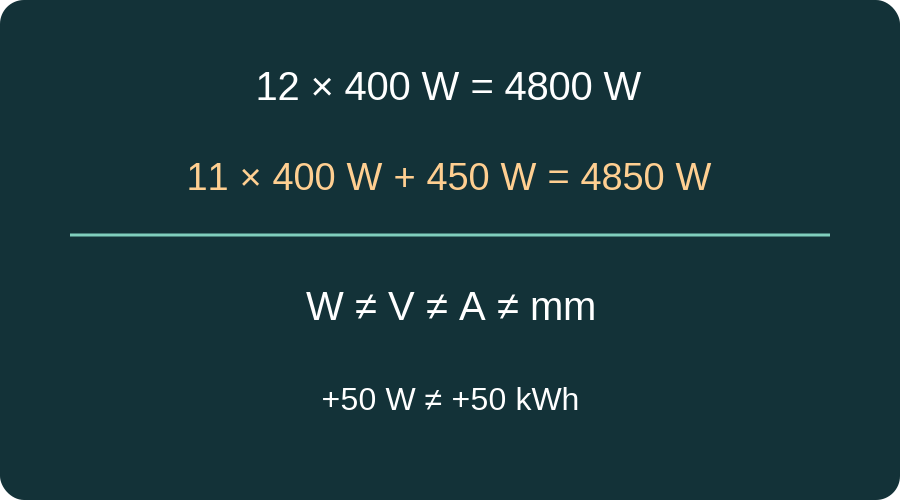
Consider an illustrative installation containing 12 modules rated at 400 W each. Its nominal module total is 4 800 W. Replacing one unit with a proposed 450 W product produces the arithmetic 11 × 400 W + 450 W = 4 850 W. The difference is 50 W of nameplate rating. This calculation describes an inventory change, not the resulting string behaviour, an approved design or an annual energy gain. It deliberately leaves the electrical and mechanical assessment unresolved because those require information that the headline ratings do not contain.
Do not multiply that 50 W difference by a sunshine assumption and present the result as guaranteed extra electricity. Actual output depends on the complete installation, operating conditions and any limitations identified by the designer. The same caution applies to a replacement with a lower nominal rating: apparent similarity does not establish its suitability either. Use this example to ask why an offer was selected and which constraints were checked. A transparent repair file separates the simple equipment arithmetic from engineering acceptance and from any later observation of production after commissioning.
Read the quotation as a complete intervention
Require separate, intelligible lines for diagnosis, access equipment, module supply, mounting adaptations, electrical work, necessary checks, transport, removal and handover documentation. Ask whether the price includes roofing work, coordination with another contractor and arrangements for an unavailable item. Clarify the treatment of additional damage discovered during inspection and obtain a process for approving variations. A short description such as replacement panel with fitting gives too little information to compare offers or to decide whether a later invoice contains work that was originally promised.
Use the site's quotation comparison method to align the scope before comparing totals. Request a realistic availability statement rather than a delivery promise based on an unverified marketplace listing. Record who bears storage and return costs if the delivered reference is not the approved one. Where scaffolding is already planned for roof work, ask whether access can be shared and how the responsibilities remain separated. Coordination may improve the programme, but an assumed saving should not be booked until the contractors have actually agreed the arrangement.
Check old stock and second-hand equipment carefully
A discontinued product may still be offered from warehouse stock or another installation. Ask for its exact reference, serial identification, storage history, condition, seller identity and supporting paperwork. Separate a manufacturer's warranty from a distributor's commercial promise and from the installer's workmanship responsibility. A statement that a module is unused does not explain how it was transported or stored. Similarly, a removed module's age alone does not reveal whether it experienced damage, an unsuitable repair or an operating condition relevant to its future use.
The professional should decide what assessment is needed before accepting such equipment. Do not buy an anonymous unit merely to preserve the original roof appearance. Ask whether the owner will receive the available test evidence and a clear explanation of its limits. If uncertainty remains, have the alternative repair approach priced explicitly instead of hiding the uncertainty behind a discount. Retain the listing and order confirmation because descriptions can change or disappear. A traceable supply chain helps with later claims, but it is not itself proof that a particular component is suitable for your installation.
Keep warranty, insurance and administrative questions separate
Before authorising removal, ask the relevant parties which photographs, identifiers or inspection findings they need and whether the affected component must be preserved for examination. Record the claim number and the person authorising the next step where an insurance or warranty case is involved. Do not assume that a replacement automatically renews the warranty of the entire array or that the same organisation covers workmanship, product defects and consequential roof damage. Each answer should identify the particular contract, equipment and responsibility to which it relates.
The ESTI explanation of electrical installation records helps distinguish technical documentation from a commercial guarantee. Ask the appointed company which controls, notifications and updated records are required for the actual work. If installed power or other recorded characteristics change, clarify the applicable network and Pronovo processes before treating the repair as administratively complete. Preserve the original installation history in your own records: the repair date should be added as a new event, not used to erase the identity or age of the existing system.
Send a request that lets a professional make a decision
Organise the enquiry around the site, observed fault, original reference, available documentation and the decision you need. Attach the equipment sheet, accessible photographs, relevant monitoring extracts and previous correspondence. State whether you seek the smallest justified repair, an alternative if original stock is unavailable, or a comparison with a larger refurbishment. Ask the company to identify missing information before quoting a definitive solution. This makes the response more useful than asking whether any modern panel with approximately the same dimensions will work.
Request a written description of the accepted replacement, the reason it is suitable, the planned intervention boundary and the documents delivered at completion. Add practical constraints such as shared roof access, a tenant's availability, an insurer's inspection appointment or an upcoming roof renovation. Keep commercial approval separate from acceptance of a technical substitution: agreeing to a price is not a substitute for identifying the product. If the offer permits an equivalent reference, specify how that equivalence will be documented and approved before installation, rather than leaving the decision to an unexplained delivery substitution.
Verify the handover before closing the repair file
At completion, collect the invoice, installed product reference, serial identification where available, updated layout, relevant inspection or commissioning documents and the agreed warranty information. Ask the professional to identify which existing records remain applicable and which have been superseded. Confirm that the monitoring equipment names and roof positions correspond to the physical change. A new module displayed under an old label can make later troubleshooting confusing, especially if a different company takes over maintenance or the house is sold.
Agree how normal operation will be observed after the repair, allowing for weather and the limits of the available monitoring. A single sunny afternoon does not establish annual performance, while a brief communication interruption does not necessarily establish another hardware fault. Record the observations and the contact for unresolved questions. If roof renovation will also require temporary removal, use the separate removal and reinstallation guide so that the same access, inventory and documentation tasks are coordinated rather than paid for twice without discussion.
Keep a compact decision checklist
Print or copy the following fields into the repair file. The checklist is complete when each point has an identifiable answer or an explicitly assigned follow-up, not merely when every box has been ticked. Unknown information should have an owner and a next action. That makes the sheet useful when the installer, insurer, equipment supplier and homeowner hold different parts of the evidence and cannot resolve everything during the same visit.
- Original module reference, variant and accessible serial evidence recorded.
- Fault diagnosis distinguished from a monitoring or shading problem.
- Proposed replacement identified before purchase or delivery approval.
- Electrical, mounting and connector compatibility addressed in writing.
- Complete intervention scope, availability and variation process agreed.
- Warranty, insurance, notification and document responsibilities allocated.
- Removed equipment retained or disposed of according to the agreed process.
- Handover records and a proportionate operating follow-up received.
The next step is a documented professional assessment of the actual installation. Use the relevant existing guides to prepare the questions, then compare proposals on the same scope. The objective is a repair whose choice remains understandable after the sales listing has disappeared, the original installer has changed personnel or the property has changed hands. A higher rating can be attractive, but a defensible replacement depends on the complete equipment relationship and the evidence retained by its owner.